
Embarking on a pilgrimage to Badrinath, one of the most sacred shrines in the Char Dham Yatra, is a spiritually transformative journey that begins for many devotees in the holy city of Haridwar. As you plan this divine expedition through the majestic Himalayas, understanding the Haridwar to Badrinath distance becomes crucial for effective trip planning. The distance between Haridwar to Badrinath is approximately 315-320 kilometers by road, a journey that takes you through breathtaking mountain landscapes, sacred confluences, and ancient pilgrimage routes.
This comprehensive guide will walk you through everything you need to know about the Haridwar to Badrinath distance by road, including detailed route information, travel time by different modes of transport, essential stops along the way, and practical tips to make your pilgrimage smooth and memorable. Whether you’re considering the Haridwar to Badrinath distance by bus or the Haridwar to Badrinath distance by taxi, we’ll help you make informed decisions for your sacred journey to Lord Vishnu’s abode nestled in the Garhwal Himalayas.
Haridwar to Badrinath Distance – Complete Overview
Exact Distance Details
The distance between Haridwar to Badrinath by road is approximately 315-320 kilometers, depending on the specific route taken and minor diversions. The Badrinath to Haridwar distance remains the same for the return journey, covering identical terrain in reverse. It’s important to note that while the aerial or straight-line distance between these two points is considerably shorter (around 160 kilometers), the actual road distance is nearly double due to the winding mountain roads that navigate through the Himalayan terrain.
Understanding the Haridwar to Badrinath distance is essential for several reasons. It helps you plan your departure time, budget for fuel or transportation costs, arrange accommodation if needed, and mentally prepare for the journey’s duration. The route takes you from Haridwar’s elevation of 314 meters to Badrinath’s impressive altitude of 3,300 meters, making this not just a horizontal journey but a significant vertical ascent through multiple climate zones.
Distance Breakdown by Major Stops
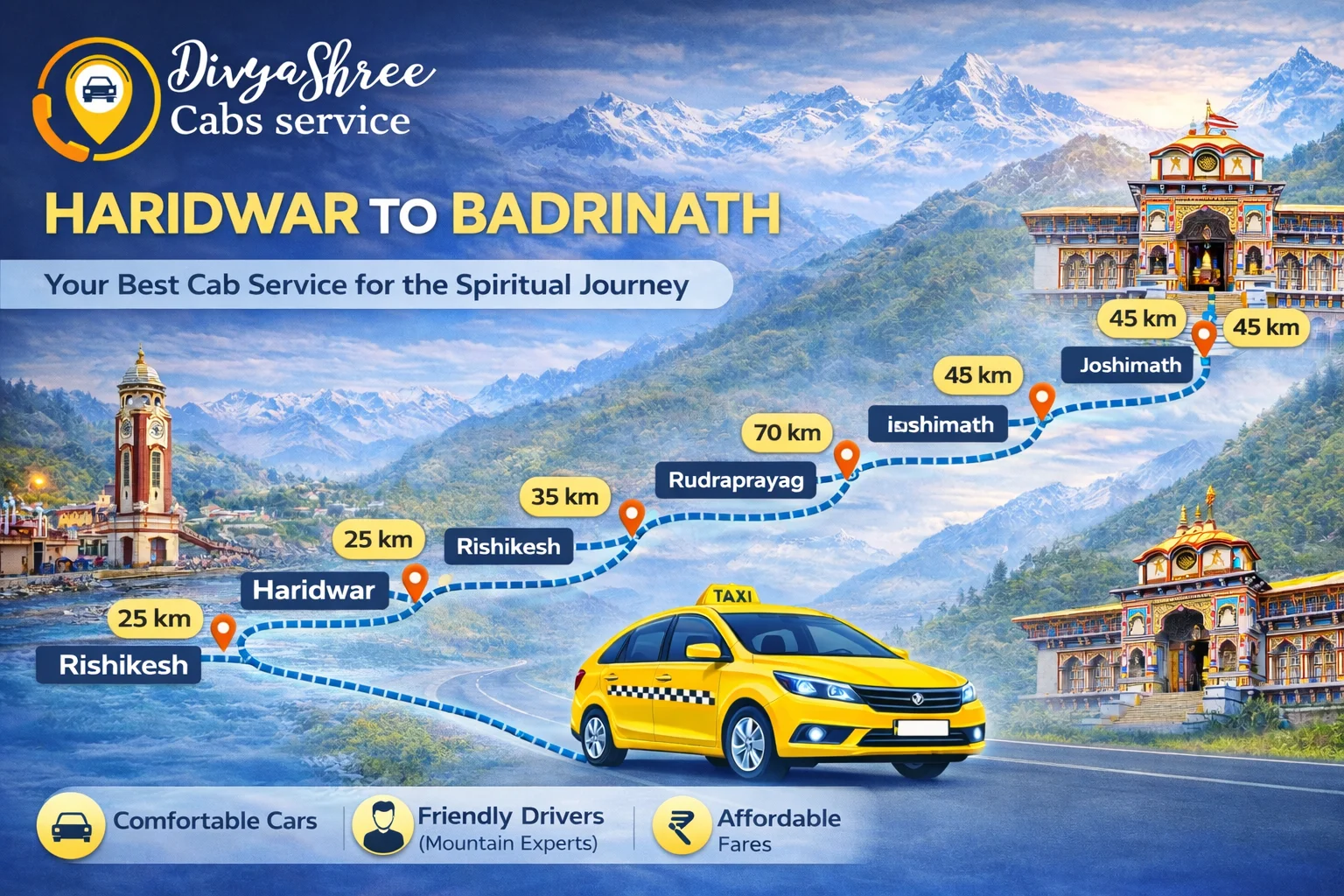
To better understand the distance between Haridwar and Badrinath, here’s a detailed breakdown of the route with approximate distances between major stops:
- Haridwar to Rishikesh: 25 km
- Rishikesh to Devprayag: 70 km
- Devprayag to Rudraprayag: 35 km
- Rudraprayag to Karnaprayag: 35 km
- Karnaprayag to Chamoli: 18 km
- Chamoli to Joshimath: 45 km
- Joshimath to Badrinath: 45 km
Total distance between Haridwar and Badrinath: Approximately 315-320 km
This segmented breakdown helps travelers plan their stops, estimate fuel requirements, and identify suitable rest points along the journey. Each segment offers unique landscapes and spiritual significance, transforming the distance between Haridwar to Badrinath into a pilgrimage experience rather than merely a commute.
Alternative Routes
The primary and most recommended route for covering the Haridwar to Badrinath distance by road is via National Highway 58 (NH 58) up to Rishikesh and then NH 7 (previously NH 58) onwards through Devprayag, Rudraprayag, and Joshimath. This is the most direct, well-maintained, and safest route available.
While there aren’t significant alternative routes for this specific journey, some travelers choose to combine their Badrinath visit with other Char Dham destinations, which would alter the route. However, for a direct journey focused solely on the distance between Badrinath to Haridwar, the NH 58 and NH 7 corridor remains the standard and recommended path, offering reliable road conditions, adequate facilities, and stunning Himalayan vistas throughout.
Haridwar to Badrinath Distance by Road – Detailed Route Guide
The Main Highway Route
The Haridwar to Badrinath distance by road follows a well-established pilgrimage route that has been traveled by devotees for centuries, now modernized with improved highways. The journey begins on National Highway 58 from Haridwar, proceeding through the following route:
Haridwar → Rishikesh → Devprayag → Rudraprayag → Karnaprayag → Chamoli → Joshimath → Badrinath
The route initially follows NH 58, one of India’s most scenic highways, before transitioning to NH 7 as you venture deeper into the Garhwal Himalayas. From Haridwar’s bustling ghats, the road takes you alongside the holy Ganges (which becomes the Alaknanda in the upper reaches), passing through the spiritual town of Rishikesh within the first 25 kilometers.
Beyond Rishikesh, the Haridwar to Badrinath distance by road becomes increasingly mountainous. You’ll witness the sacred Panch Prayags (five confluences) where different tributaries merge with the Alaknanda River. At Devprayag, the Bhagirathi and Alaknanda converge to form the Ganges. Further along at Rudraprayag, the Mandakini joins the Alaknanda, and at Karnaprayag, the Pindar River merges with the Alaknanda.
The road conditions vary throughout the journey. The Haridwar to Rishikesh stretch is excellent, featuring a wide, well-paved highway. From Rishikesh to Devprayag, roads are generally good but begin to narrow. The sections from Devprayag through Rudraprayag and Karnaprayag to Joshimath feature typical mountain roads with some challenging stretches, especially during monsoon season. The final 45-kilometer push from Joshimath to Badrinath takes you through high-altitude terrain with spectacular views of snow-capped peaks.
Journey Characteristics
Covering the distance between Haridwar to Badrinath requires navigating typical Himalayan mountain road conditions. The route features numerous hairpin bends, particularly in the sections beyond Rudraprayag. These switchbacks are necessary to gain altitude gradually and require careful driving, especially in larger vehicles.
The elevation gain throughout the journey is significant and gradual. Starting from Haridwar at 314 meters above sea level, you ascend to Rishikesh (372 meters), then to Devprayag (830 meters), Rudraprayag (895 meters), Karnaprayag (1,451 meters), Joshimath (1,890 meters), and finally Badrinath at 3,300 meters. This 3,000-meter elevation gain over 315 kilometers means you’ll experience changing climate zones, vegetation patterns, and temperature variations.
Road quality is best during the summer pilgrimage season (May to October) when maintenance is prioritized. The Haridwar to Badrinath distance by road can become challenging during monsoon months (July-August) due to occasional landslides and road blockages. Winter months see the upper sections beyond Joshimath becoming inaccessible due to heavy snowfall. The most challenging sections typically include steep gradients near Chamoli and the high-altitude stretch to Badrinath, where oxygen levels are noticeably lower.
The roads are generally single-lane or narrow two-lane highways with wider passing points. Traffic management is implemented during peak pilgrimage season, with one-way traffic regulations sometimes enforced on particularly narrow sections.
Important Landmarks and Stops
As you cover the Badrinath to Haridwar distance by road, several significant landmarks and stops deserve attention:
Rishikesh (25 km from Haridwar): Known as the Yoga Capital of the World, Rishikesh offers the iconic Laxman Jhula and Ram Jhula suspension bridges, numerous ashrams, and the mesmerizing Ganga Aarti at Triveni Ghat. This spiritual town serves as the gateway to the Himalayas.
Devprayag (95 km from Haridwar): This sacred confluence where the Bhagirathi and Alaknanda rivers meet to form the Ganges is a must-stop location. The distinct colors of the two rivers merging create a visually stunning spectacle. The ancient Raghunath Temple here is worth visiting.
Rudraprayag (130 km from Haridwar): Named after Lord Shiva (Rudra), this town sits at the confluence of the Alaknanda and Mandakini rivers. The Chamunda Devi Temple and Koteshwar Mahadev Temple carved into a cave are significant attractions.
Karnaprayag (165 km from Haridwar): This confluence point where the Pindar River joins the Alaknanda is associated with the Mahabharata’s Karna. The Uma Devi Temple here is an important pilgrimage site.
Joshimath (270 km from Haridwar): The last major town before Badrinath serves as the winter seat of Lord Badrinath’s deity when the main temple closes. The Narsingh Temple here is highly revered. Joshimath is also the base for treks to Valley of Flowers and Hemkund Sahib.
Vishnuprayag (280 km from Haridwar): The confluence of Dhauliganga and Alaknanda rivers, considered highly sacred.
Popular photo stops include the panoramic viewpoints near Byung, the Alaknanda River valleys, and various Himalayan peaks visible from different points along the route.
Haridwar to Badrinath Distance by Bus
Bus Service Overview
Covering the Haridwar to Badrinath distance by bus follows the same 315-320 kilometer route via NH 58 and NH 7. Bus services are operated by both government agencies and private operators, providing budget-friendly transportation options for pilgrims.
The Uttarakhand Transport Corporation (UTC) and Uttarakhand State Road Transport Corporation (UPSRTC) operate regular government bus services on this route during the pilgrimage season (typically May to November). These buses depart from Haridwar Bus Stand and offer both ordinary and deluxe categories. Private operators also run buses, particularly during peak season, with varying levels of comfort from standard seater buses to semi-sleeper and sleeper coaches.
Government buses are generally more economical but may be less comfortable, while private deluxe buses offer better seating, cleaner interiors, and sometimes include basic amenities like charging points. The choice between options depends on your budget and comfort preferences for the lengthy journey.
Bus Journey Details
Buses covering the Haridwar to Badrinath distance by bus typically depart from the main Interstate Bus Terminal (ISBT) in Haridwar, also known as Haridwar Bus Stand. During peak pilgrimage season (May-June and September-October), multiple buses depart daily, usually in the early morning hours between 4:00 AM and 7:00 AM to ensure arrival before nightfall.
Direct bus services to Badrinath are available but may not run daily outside peak season. During off-peak times or winter months when Badrinath temple is closed, connectivity reduces significantly. Many travelers may need to take connecting services, changing buses at Rishikesh, Rudraprayag, or Joshimath.
The typical travel time for the Haridwar to Badrinath distance by bus ranges from 12 to 14 hours, depending on road conditions, traffic, number of stops, and weather. This is longer than taxi travel due to fixed stops for passenger boarding and meal breaks.
Ticket prices vary by bus category. Ordinary government buses typically charge between ₹400-600, while deluxe government buses range from ₹700-1,000. Private deluxe and semi-sleeper buses can cost between ₹800-1,500 depending on amenities and season. Prices increase during peak pilgrimage periods due to high demand.
Booking can be done through the UTC/UPSRTC official website or app for government buses, at the bus terminal ticket counters, or through authorized travel agents. For private buses, booking is available through various online bus booking platforms or directly with operators. Advance booking is highly recommended during peak season as seats fill quickly.
Bus Travel Experience
The comfort level when covering the distance between Haridwar to Badrinath by bus varies significantly based on the category chosen. Ordinary buses have basic seating with limited legroom and no special amenities. Deluxe buses offer cushioned seats, more space, and sometimes air conditioning for the lower altitude sections. Semi-sleeper buses provide reclinable seats for added comfort during the long journey.
Scheduled stops are made at predetermined points for breakfast, lunch, and refreshment breaks. Common stop locations include Rishikesh, Devprayag, Rudraprayag, and Joshimath. These breaks typically last 15-30 minutes, allowing passengers to use restrooms, purchase food, and stretch their legs. Some operators include basic meal costs in the ticket price, while others leave it to passengers.
For overnight journeys or very early morning departures, carrying a light blanket or shawl is advisable as temperatures drop significantly in mountain areas. Warm clothing is essential even if departing from warm Haridwar, as Badrinath’s high-altitude location is considerably colder.
Advantages of bus travel:
- Most economical option for covering the Haridwar to Badrinath distance
- No driving responsibilities, allowing you to rest or enjoy scenery
- Regular services during pilgrimage season
- Meets other pilgrims and fellow travelers
- Operators familiar with route and mountain driving
Disadvantages:
- Fixed departure schedules with limited flexibility
- Longer journey time compared to taxi (12-14 hours vs 9-11 hours)
- Less comfortable, especially on winding mountain roads
- Limited luggage space
- Cannot customize stops for sightseeing
- May be challenging for elderly or those with mobility issues
Tips for comfortable bus journey:
- Book window seats for better views and natural ventilation
- Carry motion sickness medication if prone to travel sickness
- Keep warm clothes, water, and snacks handy
- Carry essential medicines and ID proofs
- Use rest stops to walk around and prevent stiffness
- Keep valuables in secure, accessible bags
Bus Stations and Stops
The journey begins at Haridwar Bus Stand (ISBT), a well-equipped terminal with ticket counters, waiting areas, restrooms, and food stalls. Located in the heart of Haridwar, it’s easily accessible from all parts of the city.
Major bus stops along the Haridwar to Badrinath distance by bus route:
Rishikesh Bus Stand: A major hub with extensive facilities including restaurants, shops, ATMs, and accommodation options nearby. This is a common transfer point for those taking connecting buses.
Devprayag: A smaller stop with basic facilities, tea stalls, and small eateries serving local cuisine. The stop allows pilgrims to view the sacred confluence.
Rudraprayag: A significant stop with better facilities including restaurants, medical shops, and small hotels. Several food options are available.
Karnaprayag: Moderate facilities with food stalls and basic amenities. A brief stop for most buses.
Joshimath: The last major town before Badrinath offers the most comprehensive facilities with restaurants, hotels, ATMs, medical facilities, and shops. This is the final stop for refueling, meals, and any last-minute purchases before the final leg to Badrinath.
Most stops have basic facilities like restrooms (though cleanliness varies), tea shops, and simple food outlets serving local dishes, parathas, rice meals, and snacks. Carrying your own water and light snacks is advisable as quality and hygiene standards vary at roadside stops.
Haridwar to Badrinath Distance by Taxi
Taxi Journey Overview
Covering the Haridwar to Badrinath distance by taxi remains the most popular and comfortable option for pilgrims and tourists. The same 315-320 kilometer route is followed, but with significantly enhanced flexibility, comfort, and time efficiency compared to bus travel.
Taxi travel is particularly favored for several reasons. It offers door-to-door service from your hotel or residence in Haridwar directly to your accommodation in Badrinath. You can customize your departure time, stop at desired locations for sightseeing or photography, and travel at your own pace. For families, groups, or elderly pilgrims, the comfort and convenience of a private taxi make the considerable distance between Haridwar to Badrinath much more manageable.
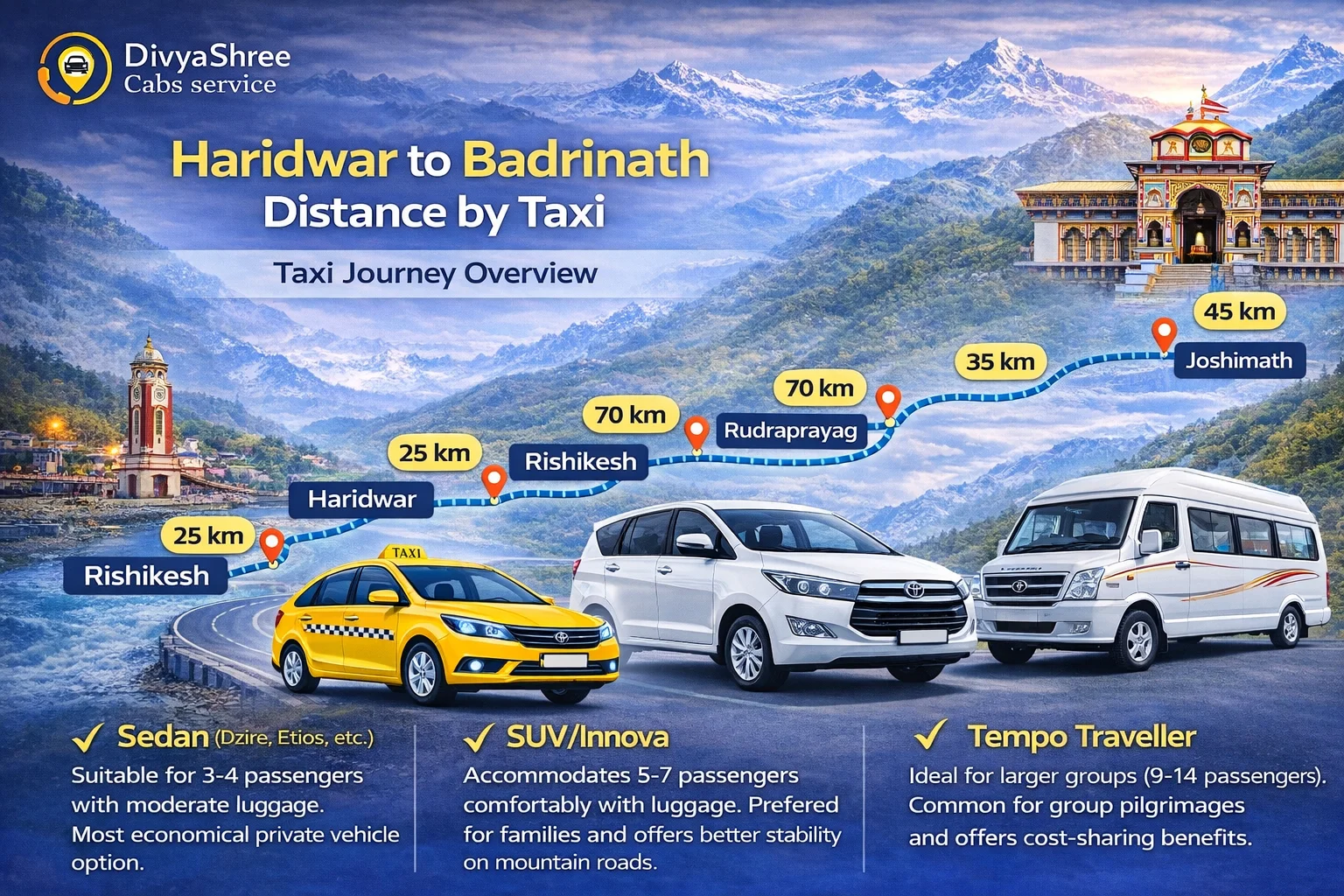
Several types of vehicles are available for hire:
Sedan (Dzire, Etios, etc.): Suitable for 3-4 passengers with moderate luggage. Most economical private vehicle option.
SUV/Innova: Accommodates 5-7 passengers comfortably with luggage. Preferred for families and offers better stability on mountain roads.
Tempo Traveller: Ideal for larger groups (9-14 passengers). Common for group pilgrimages and offers cost-sharing benefits.
All taxi services typically provide experienced drivers who are familiar with the mountain roads and local conditions, an invaluable asset when navigating the challenging terrain.
Taxi Travel Time
The estimated duration to cover the Haridwar to Badrinath distance by taxi is typically 9 to 11 hours under normal conditions. This is approximately 2-3 hours faster than bus travel, primarily due to fewer stops and the ability to maintain optimal speed based on road conditions.
Several factors affect the actual travel time:
Weather conditions: Clear weather allows for faster travel, while fog, rain, or snow can significantly increase journey time and require cautious driving.
Road conditions: During monsoon season (July-August), landslides may cause delays or require brief waiting periods for road clearance. Post-monsoon and winter seasons may have debris or minor road damage affecting speed.
Season and traffic: Peak pilgrimage season (May-June) sees heavy traffic, especially near popular stops and narrow sections, potentially adding 1-2 hours to journey time. Off-peak travel is considerably faster.
Number and duration of stops: The more sightseeing and meal stops you take, the longer the total journey time. A journey with minimal stops can be completed in 9 hours, while one with extensive photography and sightseeing breaks might extend to 12 hours.
Driver experience and comfort: Experienced drivers familiar with the route navigate more efficiently. However, safety should never be compromised for speed.
Compared to the 12-14 hour bus journey covering the same distance between Badrinath to Haridwar, taxi travel offers a significant time advantage. This extra time can be used for rest before temple darshan or to explore Badrinath and nearby attractions like Mana Village.
The flexibility in journey timing is perhaps the greatest advantage. You can start early (5-6 AM is recommended) to avoid traffic and reach Badrinath by evening, allowing for a comfortable night’s rest before morning temple darshan. Alternatively, you can start later if needed, though arriving before dark is always advisable for mountain travel safety.
Taxi Fare and Booking
Approximate fare ranges for covering the Haridwar to Badrinath distance by taxi vary based on vehicle type and season:
Sedan (Dzire, Etios): ₹8,000-12,000 for one-way SUV/Innova: ₹12,000-16,000 for one-way Tempo Traveller (12-14 seater): ₹18,000-25,000 for one-way
Round-trip pricing typically offers better value, ranging from ₹16,000-24,000 for sedans and ₹24,000-32,000 for SUVs, often including driver accommodation and multiple-day packages.
Seasonal price variations are significant. During peak pilgrimage season (May-June and September-October), fares can increase by 20-30% due to high demand. Off-peak season or weekday travel may offer discounted rates. Festival periods like Badri Kedar Festival also see price surges.
What’s typically included in taxi fare:
- Vehicle with fuel for the specified route
- Experienced driver services
- Driver’s food and accommodation (for multi-day trips)
- Toll charges and interstate permits
- Basic vehicle insurance
Additional costs not usually included:
- Passenger meals and accommodation
- Entry fees to attractions
- Parking charges at certain locations
- Extra hours beyond agreed itinerary
- Deviations from standard route
How to book reliable taxi services:
Research reputable operators with good reviews and proper registration. Book through established travel agencies, hotel recommendations, or verified online platforms. Confirm all details in writing including vehicle type, fare breakdown, inclusions, driver details, and emergency contact numbers.
Advance booking is highly recommended, especially 2-3 weeks before peak season travel. Last-minute bookings may face limited availability and inflated prices. Many operators require 20-30% advance payment, with balance payable after journey completion.
Verify that the taxi service provides drivers experienced in mountain driving, has proper vehicle fitness certificates, and offers customer support during the journey.
Advantages of Taxi Travel
The benefits of covering the Haridwar to Badrinath distance by taxi are numerous:
Flexible departure timing: Unlike buses with fixed schedules, you can start your journey at your preferred time. Early morning departures (5-6 AM) are popular for reaching Badrinath by evening.
Customizable stops for sightseeing and photography: Stop at Devprayag to witness the confluence, capture photographs at scenic viewpoints, visit temples at Rudraprayag or Karnaprayag, and take breaks whenever needed. This transforms the journey into an experiential pilgrimage rather than just transportation.
Comfort and privacy: Travel with your family or group in your own space without sharing with strangers. Control the temperature, music, and conversation environment. Stretch your legs, store luggage conveniably, and maintain personal comfort throughout.
Faster than bus travel: Covering the distance between Haridwar and Badrinath 2-3 hours faster allows for better time management, less fatigue, and more time at your destination.
Suitable for families and elderly pilgrims: The door-to-door service, ability to take breaks as needed, and more comfortable seating make taxi travel ideal for senior citizens, families with children, or those with health considerations. The journey’s physical demands are significantly reduced.
Experienced drivers familiar with mountain roads: Professional drivers who regularly navigate this route understand the road conditions, weather patterns, ideal stopping points, and local insights. They ensure safety while optimizing travel time and can provide valuable information about the region.
Personal assistance: Drivers often help with luggage, provide local recommendations, assist with finding accommodation if needed, and serve as guides for the region’s geography and culture.
Taxi vs Bus – Distance Coverage Comparison
When deciding between taxi and bus for the distance between Haridwar to Badrinath, consider these comparisons:
Time efficiency:
- Taxi: 9-11 hours
- Bus: 12-14 hours
- Winner: Taxi (saves 2-3 hours)
Cost comparison (per person):
- Taxi sedan shared among 4 people: ₹2,000-3,000 per person
- Taxi SUV shared among 6 people: ₹2,000-2,700 per person
- Bus deluxe: ₹700-1,000 per person
- Bus ordinary: ₹400-600 per person
- Winner: Bus for solo travelers; Taxi for groups of 3+
Comfort comparison:
- Taxi: Personalized space, AC, controlled stops, better seating
- Bus: Shared space, fixed schedule, limited legroom
- Winner: Taxi (significantly more comfortable)
Best choice based on scenarios:
- Solo budget traveler: Bus
- Couple or family: Taxi
- Group of 4-6: Taxi (cost-effective when split)
- Elderly or health concerns: Taxi
- Tight budget, flexible time: Bus
- Limited time, prefer comfort: Taxi
- Want sightseeing flexibility: Taxi
Travel Time from Haridwar to Badrinath
Time Required by Different Modes
Understanding the time investment required to cover the distance between Haridwar to Badrinath helps in realistic trip planning:
By taxi: 9-11 hours is the standard duration under normal conditions. Early morning departures (5-6 AM) typically result in arrival by 3-5 PM, accounting for meal breaks and brief photo stops.
By bus: 12-14 hours is typical for government and private bus services. Buses departing at 5-6 AM usually reach Badrinath by 6-8 PM, sometimes later depending on traffic and stops.
By private car (self-drive): 9-10 hours for experienced drivers familiar with mountain roads. First-time visitors might take 11-12 hours due to cautious driving on unfamiliar terrain.
Factors influencing travel duration across all modes:
- Traffic congestion during peak pilgrimage season
- Weather conditions (fog, rain, snow)
- Road maintenance or construction work
- Landslide clearance during monsoon
- Number and duration of stops for meals, rest, and sightseeing
- Driver/vehicle speed and efficiency
- Time of day (early morning travel is typically faster)
Time Management Tips
Effective time management enhances your experience when covering the Haridwar to Badrinath distance by road:
Best departure time from Haridwar: Starting between 5:00 AM and 6:00 AM is ideal. Early departure offers several advantages including cooler temperatures in lower altitudes, less traffic, better visibility before afternoon cloud cover, and arrival at Badrinath with sufficient daylight for check-in and acclimatization.
Expected arrival time at Badrinath: With a 5-6 AM departure and standard stops, expect to arrive between 3:00 PM and 6:00 PM. This allows time to settle into accommodation, acclimatize to the altitude, and rest before the next day’s temple darshan.
Accounting for meal breaks and rest stops: Plan for at least three major stops totaling 1.5-2 hours: breakfast stop at Rishikesh or Devprayag (30 minutes), lunch at Rudraprayag or Karnaprayag (45-60 minutes), and short refreshment breaks (15-20 minutes total). Additional photo stops add time but enrich the journey experience.
Traffic considerations during peak season: May-June and September-October see maximum pilgrim traffic. Narrow sections near Joshimath and single-lane stretches may have traffic jams adding 1-2 hours to journey time. One-way traffic systems implemented on certain sections during peak periods should be factored into planning.
Weather-related delays: Monsoon season (July-August) poses the highest risk. Morning fog can delay departure or slow travel in upper reaches. Afternoon thunderstorms in mountains are common. Winter months beyond November see upper sections closed due to snow.
Landslide risks during monsoon: The Haridwar to Badrinath distance by road crosses several landslide-prone zones. During monsoon, minor slides are common and usually cleared within 1-2 hours. Major slides can cause longer delays. Checking road status before departure during monsoon is advisable.
Breaking the Journey
While the distance between Haridwar to Badrinath can be covered in one day, breaking the journey offers several benefits:
Whether to complete in one day or break journey: For most travelers, completing the journey in one day is feasible and common. However, those concerned about altitude sickness, traveling with elderly family members, or preferring a relaxed pace should consider an overnight stop.
Recommended overnight stop options:
Rudraprayag (130 km from Haridwar): Offers decent hotels and guesthouses. This allows for a comfortable first day covering less than half the distance, with a fresh start the next morning for the remaining 140 km to Badrinath.
Joshimath (270 km from Haridwar): The most popular overnight stop option. With good accommodation ranging from budget to comfortable hotels, staying here means an easy 45 km journey to Badrinath the next morning. This also aids altitude acclimatization, as Joshimath sits at 1,890 meters, preparing your body for Badrinath’s 3,300-meter elevation.
Benefits of breaking the journey:
- Reduced fatigue, especially for elderly travelers
- Better altitude acclimatization, minimizing risk of altitude sickness
- Time to explore intermediate destinations and temples
- More relaxed, less rushed experience
- Better rest before Badrinath temple darshan
Two-day itinerary suggestion:
Day 1: Depart Haridwar at 6-7 AM, stop at Rishikesh for breakfast and brief sightseeing (Laxman Jhula, Ram Jhula), continue to Devprayag to witness the confluence, lunch at Rudraprayag, visit Rudraprayag temples, reach Joshimath by 4-5 PM. Evening visit to Narsingh Temple. Overnight in Joshimath.
Day 2: Early morning departure at 6-7 AM from Joshimath, scenic 45 km drive to Badrinath, arrival by 8-9 AM. Check into hotel, acclimatize, visit Badrinath Temple for darshan, explore Mana Village (last Indian village), see Vyas Gufa and Ganesh Gufa. Evening aarti at Badrinath Temple.
This two-day approach is particularly recommended for first-time visitors and those unfamiliar with high-altitude travel.
Best Time to Travel from Haridwar to Badrinath
Season-wise Travel Conditions
The Badrinath to Haridwar distance by road offers vastly different experiences depending on when you travel:
Summer (May-June): This is the peak pilgrimage season and the best time for covering the Haridwar to Badrinath distance. Weather is pleasant with clear skies and comfortable daytime temperatures in lower altitudes (20-30°C) and cooler mountain temperatures (10-15°C during day). Badrinath itself remains cold even in summer (5-15°C). Roads are in best condition with regular maintenance. All facilities along the route operate fully. The main disadvantage is heavy tourist traffic, crowded accommodation, and higher prices. Temple darshan may require long waiting times.
Monsoon (July-August): This period presents the most challenging conditions for the journey. Heavy rainfall causes frequent landslides, road blockages, and travel delays. The Haridwar to Badrinath distance by road becomes riskier with slippery conditions and reduced visibility. While the landscapes are lush and beautiful, and crowds are fewer, the safety concerns and travel unpredictability make this the least recommended period. Only experienced travelers comfortable with uncertainties should travel during monsoon. Always check road status and weather forecasts before departure.
Autumn (September-October): Considered by many as the ideal time for the pilgrimage. Post-monsoon clarity offers crystal-clear mountain views and spectacular scenery. Weather is pleasant and stable with comfortable temperatures. Roads are cleared and maintained after monsoon. Crowds begin to thin compared to peak summer, making for a more peaceful experience. Prices moderate from peak season rates. This season combines good weather with fewer crowds, offering the best balance.
Winter (November-April): The Badrinath temple closes for winter (usually in November) and the entire deity is moved to Joshimath for the winter months. Heavy snowfall makes the road beyond Joshimath inaccessible and dangerous. The upper sections of the route are closed to traffic. Travel is not possible or advisable during this period for Badrinath-specific pilgrimage, though the Haridwar to Joshimath section remains accessible for those visiting Auli or attending winter festivals.
Temple Opening Dates
Planning your trip around Badrinath temple’s operational calendar is crucial:
Badrinath temple opening (Akshaya Tritiya): The temple typically opens in late April or early May, coinciding with the auspicious day of Akshaya Tritiya. The exact date follows the Hindu lunar calendar and varies each year. The opening ceremony, called “Kapaat Kholna,” is a significant event attended by thousands of pilgrims. Specific dates are announced by the Badrinath-Kedarnath Temple Committee.
Closing dates (Vijayadashami/Diwali): The temple closes for winter in October or November, usually around Diwali or shortly after Vijayadashami. The closing ceremony, “Kapaat Bandh,” is equally significant. The deity is then moved to Joshimath’s Vasudeva Temple for winter worship.
Importance of checking temple calendar before planning: Before booking travel or arranging to cover the distance between Haridwar and Badrinath, verify the temple’s opening and closing dates for your intended travel year. Arriving when the temple is closed results in a wasted journey, as the primary purpose of most pilgrimages cannot be fulfilled. Check the official Badrinath-Kedarnath Temple Committee website or reliable sources for confirmed dates.
The opening and closing periods witness maximum crowds, making travel challenging but spiritually significant. Many devotees specifically aim to attend these ceremonies despite the difficulties.
Peak vs Off-Peak Travel
Understanding peak versus off-peak patterns helps optimize your journey:
Impact on road traffic and travel time: Peak season (May-June) sees bumper-to-bumper traffic on narrow mountain sections, potentially adding 2-3 hours to the standard Haridwar to Badrinath distance travel time. Off-peak periods (September-October, early May, late October) offer smoother traffic flow and faster journey times.
Accommodation availability: Peak season requires advance booking (2-3 weeks minimum) for decent hotels in Badrinath and Joshimath. Prices are highest, and quality options fill quickly. Off-peak season offers better availability, lower prices (sometimes 30-40% discounts), and more negotiating power for room selection.
Taxi and bus availability: During peak season, all transportation modes operate at maximum capacity. Booking taxis well in advance is essential, and even then, prices are at their highest. Multiple bus services run daily. Off-peak season sees reduced bus frequencies but better taxi availability with more competitive pricing.
Crowd management: Peak season temples have long queues (2-4 hours wait for darshan is common). Off-peak offers quicker darshan, more peaceful temple experience, and better interaction with priests. The spiritual experience is often richer when crowds are manageable.
Important Stops and Attractions Along the Route
Must-Visit Places
The journey covering the Haridwar to Badrinath distance by road is enriched by numerous significant stops:
Rishikesh (25 km from Haridwar): Known worldwide as the Yoga Capital, Rishikesh offers spiritual and adventure experiences. The iconic Laxman Jhula and Ram Jhula suspension bridges provide stunning Ganges views. Triveni Ghat hosts evening Ganga Aarti, a mesmerizing ritual with lamps floating on the river. Numerous ashrams offer yoga and meditation sessions. The Beatles Ashram and Parmarth Niketan are popular. Adventure enthusiasts enjoy river rafting in the Ganges. Temples like Neelkanth Mahadev and Trayambakeshwar are nearby.
Devprayag (95 km from Haridwar): This sacred confluence where the Bhagirathi and Alaknanda merge to form the Ganges is deeply revered. The Raghunath Temple, believed to be over 10,000 years old, sits overlooking the confluence. The distinct colors of the two rivers—Bhagirathi’s greenish hue and Alaknanda’s brown tint—create a visible line at the meeting point. The stone steps leading to the sangam (confluence) allow pilgrims to take holy dips. The serene atmosphere and spiritual significance make this a meaningful stop.
Rudraprayag (130 km from Haridwar): Named after Lord Shiva’s fierce form (Rudra), this town sits where the Alaknanda and Mandakini rivers converge. According to mythology, Lord Shiva played the veena here to soothe Goddess Parvati. The Chamunda Devi Temple and ancient Rudranath Temple are significant. Koteshwar Mahadev Temple, carved inside a natural cave, houses a Shiva Linga and is believed to be the site where Lord Shiva meditated. The confluence point is accessible via steps for ritual baths.
Karnaprayag (165 km from Haridwar): This prayag where the Pindar River meets the Alaknanda is associated with Karna from the Mahabharata, who meditated here. The Uma Devi Temple is the main attraction. The town offers panoramic mountain views and serves as a rest point with basic facilities. The tranquil environment is perfect for a brief spiritual pause.
Joshimath (270 km from Haridwar): A crucial stop on the route, Joshimath serves as the winter seat of Lord Badrinath when the main temple closes. The Narsingh Temple houses Lord Narsingh (Vishnu’s avatar) in a sitting posture, and an interesting legend predicts the temple’s deity will eventually merge its thinning arm with the mountain, signaling Lord Badrinath’s departure from the region. Joshimath is also the base for the Valley of Flowers trek and Hemkund Sahib pilgrimage. The Shankaracharya Math, established by Adi Shankaracharya, is located here. The town offers the last reliable ATMs, fuel stations, and medical facilities before Badrinath.
Mana Village (3 km from Badrinath): India’s last village before the Tibet border is a must-visit. This ancient settlement offers insights into Himalayan life and culture. Vyas Gufa (cave) is where Ved Vyasa is believed to have composed the Mahabharata with Lord Ganesha transcribing. Ganesh Gufa nearby is where Ganesha wrote the epic. Bhim Pul, a natural rock bridge over the Saraswati River, is associated with the Pandava brother Bhima. The Saraswati River emerges here before disappearing underground. Vasudhara Falls, a 400-foot waterfall, is a short trek from Mana and is considered sacred. The village’s colorful houses, local handicrafts, and warm residents create memorable experiences.
Estimated Time at Each Stop
When planning your journey covering the distance between Haridwar and Badrinath, allocate time wisely for stops:
Quick photo stops (10-15 minutes each): Scenic viewpoints, river valleys, mountain vistas, and roadside panoramas require brief stops. Multiple such stops throughout the journey add 30-45 minutes total.
Brief temple visits (20-30 minutes each): Devprayag confluence viewing and temple, Rudraprayag temples, Karnaprayag Uma Devi Temple. If visiting 2-3 such spots, allocate 1-1.5 hours total.
Extended exploration (1-2 hours): Rishikesh requires at least 1-2 hours if exploring Laxman Jhula, Ram Jhula, and having breakfast. A full day can be spent here if time permits. Joshimath warrants 1-2 hours for Narsingh Temple and Shankaracharya Math. Mana Village exploration with treks to caves and nearby attractions needs 2-3 hours.
Meal stops (30-45 minutes each): Breakfast and lunch stops at restaurants in major towns require adequate time for freshening up and eating comfortably. Two major meal stops add 1.5 hours to journey time.
How stops affect overall travel time: Minimal stops with only essential breaks result in 9-10 hour journey time covering the Haridwar to Badrinath distance. Comprehensive sightseeing with extended stops at multiple locations can extend the journey to 12-14 hours. Balance sightseeing desires with arrival time goals, especially to reach Badrinath before dark.
Also Read: Where is Gangotri? The Ultimate Guide to Reaching the Source of the Holy Ganga
Essential Travel Tips for Haridwar to Badrinath Journey
Before You Start
Vehicle fitness check (if self-driving): Ensure your vehicle undergoes complete servicing before attempting this mountain journey. Check brakes (critical for mountain descents), engine cooling system, tire condition and pressure, suspension, lights, and battery. Carry spare tire, jack, basic tools, engine oil, and coolant. Mountain roads are demanding on vehicles, and breakdowns in remote areas pose serious challenges.
Fuel availability points along the route: Fuel stations are available at Haridwar, Rishikesh, Devprayag, Rudraprayag, Karnaprayag, Chamoli, and Joshimath. Beyond Joshimath, no fuel stations exist until Badrinath, and Badrinath itself has limited or no fuel availability. Fill your tank completely at Joshimath regardless of current fuel level. During peak season, fuel stations may have long queues; plan accordingly.
Cash requirements: While digital payments are expanding, mountain areas still operate primarily on cash. ATMs are available at Haridwar, Rishikesh, Rudraprayag, Karnaprayag, and Joshimath, but ATMs beyond Joshimath are unavailable or unreliable. Carry sufficient cash (₹10,000-15,000 recommended) for accommodation, meals, entry fees, offerings, and emergencies. Small denominations are useful for small purchases and offerings.
Mobile network coverage: Major network providers (Jio, Airtel, BSNL) have coverage in Haridwar, Rishikesh, and major towns. Coverage becomes spotty in remote mountain sections between towns. BSNL often has the most reliable coverage in mountain areas. Don’t rely entirely on mobile connectivity for navigation; download offline maps before starting. Inform family about expected communication gaps.
Valid ID proofs required: Carry original government-issued photo ID (Aadhaar Card, Passport, Driving License, Voter ID) as checkpoints along the route may verify identity, especially near sensitive border areas. Hotel check-ins require ID proof. Keep multiple photocopies as backups.
Health and Safety
Altitude sickness precautions: Badrinath sits at 3,300 meters where oxygen levels are approximately 30% lower than sea level. Altitude sickness symptoms include headache, nausea, dizziness, fatigue, and shortness of breath. To minimize risk, acclimatize gradually (overnight stop at Joshimath helps), stay hydrated (drink 3-4 liters of water daily), avoid alcohol and smoking, eat light meals, rest adequately upon arrival, and ascend slowly from Joshimath to Badrinath. If symptoms occur, descend to lower altitude immediately. Serious cases require medical attention.
Essential medicines to carry: Pack a comprehensive first-aid kit including altitude sickness medication (Diamox/Acetazolamide after consulting your doctor), pain relievers (paracetamol, ibuprofen), anti-nausea medication, motion sickness tablets, digestive aids, cold and cough medicine, antiseptic cream, bandages, personal prescription medications, and oxygen cylinders if available (can be rented in Joshimath). Consult your physician before the journey, especially if you have heart conditions, respiratory issues, or other health concerns.
Warm clothing even in summer: Temperature variations are dramatic when covering the distance between Badrinath to Haridwar. Haridwar may be hot (30-35°C in summer), while Badrinath remains cold (5-15°C during day, below freezing at night). Carry layered clothing including thermal innerwear, sweaters or fleece jackets, windproof jacket, woolen socks, gloves, cap or beanie, and comfortable walking shoes. Mornings and evenings are particularly cold at high altitudes even during peak summer.
Drinking water and snacks: Carry bottled water bottles (at least 2-3 liters per person). Refill at reliable sources in towns. Packaged snacks like biscuits, dry fruits, energy bars, and light munchies help maintain energy levels. Avoid heavy, oily, or unfamiliar foods that might upset your stomach during travel.
Emergency contact numbers: Save important numbers including local police (100), ambulance (108), Badrinath Temple Committee helpline, your taxi service provider, hotel contacts, and family emergency contacts. The Uttarakhand Police’s tourist helpline (1363) and disaster management helpline can assist in emergencies.
Road Safety
Mountain driving tips: If self-driving, stay alert as mountain roads are demanding. Use lower gears on steep climbs and descents to avoid brake overheating. Maintain safe distance from vehicles ahead (mountain roads don’t allow quick braking). Honk before blind curves to alert oncoming traffic. Give right of way to uphill traffic on narrow sections. Don’t overtake on curves or narrow stretches. Watch for falling rocks, especially during monsoon. Drive slowly and steadily; speed is dangerous on mountain roads.
Hiring experienced drivers: If hiring taxi, ensure the driver has extensive experience on the Haridwar to Badrinath distance by road route. Experienced drivers understand the terrain, weather patterns, vehicle handling on mountains, and emergency procedures. They know reliable stops for meals and rest. Verify driver’s license and experience before starting. A skilled driver transforms the journey from stressful to enjoyable.
Avoid night driving: Mountain roads are hazardous at night due to poor visibility, limited lighting, risk of vehicles without proper lights, potential wildlife crossing, and difficult navigation of narrow turns and edges. Plan to start early and reach destinations before dark. If delayed, stop at nearest town rather than driving in darkness.
Respecting local traffic rules: Follow all traffic signs and regulations. One-way traffic timings on certain narrow stretches must be strictly observed. During peak season, traffic police manage flow at challenging points; cooperate fully. Parking is restricted in certain areas; use designated spots only. Respect load restrictions on bridges. Traffic violations in mountain areas aren’t just legal issues—they pose serious safety risks.
Parking guidelines at religious sites: At temples and ghats, use designated parking areas only. Unauthorized parking causes congestion and may result in fines or vehicle towing. Badrinath Temple has specified parking zones; follow all instructions. Don’t block roads or emergency access points. Secure your vehicle properly and avoid leaving valuables visible inside.
Accommodation Planning
Booking hotels in advance during peak season: May-June peak season sees massive pilgrim influx. Book accommodation at least 2-3 weeks in advance for decent options. Last-minute bookings force acceptance of whatever is available at inflated prices, often with poor quality. Badrinath has limited quality accommodations; early booking is crucial. Joshimath offers more options but still requires advance planning during peak times.
Options in Joshimath, Badrinath: Joshimath has a wide range of accommodations from budget guesthouses (₹800-1,500 per night) to comfortable hotels (₹2,000-5,000 per night) with better facilities. Badrinath’s options are more limited and generally simpler. Government guesthouses (GMVN), temple guesthouses, and private hotels are available (₹1,000-4,000 per night). Don’t expect luxury; basic, clean accommodations are the norm. Temple guesthouses are economical and conveniently located but spartan.
Budget to luxury accommodation range: Budget accommodations (₹800-1,500) offer basic rooms with attached or shared bathrooms, limited amenities, and simple cleanliness. Mid-range options (₹2,000-3,500) provide comfortable rooms, attached bathrooms, hot water, and basic room service. Premium accommodations (₹4,000-8,000) offer better furnishings, reliable hot water, room heaters, better food, and more attentive service. True luxury is unavailable; even premium options are modest by metropolitan standards but offer maximum comfort available in the region.
Verify accommodation details including hot water availability (critical in cold weather), room heaters, food arrangements, and proximity to temple before booking. Read recent reviews from other pilgrims to set realistic expectations.
Nearby Destinations and Extended Itineraries
Char Dham Circuit
Badrinath forms one of the four sacred sites in the revered Char Dham Yatra. For pilgrims considering the complete circuit after covering the Haridwar to Badrinath distance, here’s an overview:
Badrinath as part of complete Char Dham Yatra: The four dhams are Yamunotri, Gangotri, Kedarnath, and Badrinath. Completing all four in a single season (May to October) is considered highly auspicious. Most pilgrims start from Haridwar as it’s well-connected and serves as the gateway to the Himalayas.
Distances to other Dhams from Badrinath:
- Badrinath to Kedarnath: Approximately 220 km by road via Joshimath, Chamoli, Rudraprayag, and Gaurikund (plus 19 km trek from Gaurikund)
- Badrinath to Gangotri: Approximately 270 km via Joshimath and Uttarkashi
- Badrinath to Yamunotri: Approximately 375 km via Joshimath, Uttarkashi, and Barkot (plus 6 km trek from Janki Chatti)
Multi-destination tour planning: A complete Char Dham Yatra typically requires 10-14 days. The traditional sequence is Yamunotri → Gangotri → Kedarnath → Badrinath (following the west to east direction). However, pilgrims can customize based on time and physical ability. Many tour operators offer complete packages with transportation, accommodation, and guides. Self-planned trips offer flexibility but require careful logistical coordination.
Other Attractions
The region around Badrinath offers several spectacular destinations worth exploring:
Valley of Flowers National Park: A UNESCO World Heritage Site located about 25 km from Joshimath. This high-altitude valley blooms with hundreds of wildflower species during July-August. The trek to the valley starts from Govindghat (near Joshimath) to Ghangaria (14 km) and then to the valley (3 km). The entire trek requires 2-3 days. Known for its biodiversity and spectacular mountain scenery, it’s a paradise for nature lovers and photographers.
Hemkund Sahib: A sacred Sikh pilgrimage site at 4,632 meters, featuring a gurudwara beside a glacial lake surrounded by seven snow-capped peaks. The trek starts from the same base (Ghangaria) as Valley of Flowers. The 6 km uphill trek is challenging but spiritually rewarding. Open during the same season as Badrinath (May to October), it attracts thousands of devotees and trekkers.
Auli: Located about 15 km from Joshimath, Auli is India’s premier skiing destination with slopes ranging from beginner to advanced levels. Winter months (December-February) see skiing activities, while summer offers cable car rides with panoramic Himalayan views. The meadows, oak forests, and views of Nanda Devi make it attractive year-round.
Combined tour suggestions:
- Badrinath + Mana Village + Vasudhara Falls: 2-3 days
- Badrinath + Valley of Flowers + Hemkund Sahib: 5-6 days
- Badrinath + Auli: 3-4 days
- Complete Char Dham Circuit: 10-14 days
- Do Dham (Kedarnath + Badrinath): 6-7 days
These extensions transform your journey beyond just covering the distance between Haridwar and Badrinath into a comprehensive Himalayan pilgrimage and adventure experience.
Conclusion
The journey covering the Haridwar to Badrinath distance of approximately 315-320 kilometers is far more than a mere commute between two locations. It’s a transformative pilgrimage through the majestic Himalayas, passing through sacred confluences, ancient temples, and breathtaking mountain landscapes. Whether you choose to cover the distance between Haridwar to Badrinath by road via a comfortable DivyaShree Cabs taxi in 9-11 hours or an economical bus in 12-14 hours, proper planning ensures a safe and spiritually enriching experience.
We’ve explored every aspect of this sacred journey—from exact distance breakdowns and route details to transportation options, travel times, essential stops, safety precautions, and practical tips. The Haridwar to Badrinath distance by bus and Haridwar to Badrinath distance by DivyaShree Cabs both cover the same magnificent route through Rishikesh, Devprayag, Rudraprayag, Karnaprayag, and Joshimath, each offering unique advantages suited to different traveler preferences and budgets.
The key to a successful pilgrimage is preparation. Book your transportation and accommodation in advance, especially during peak season. Start early in the morning, carry essential medicines and warm clothing, respect the challenging mountain environment, and maintain realistic expectations about travel conditions. The distance between Haridwar and Badrinath is very manageable in a single day for most travelers, though breaking the journey at Joshimath with DivyaShree Cabs offers added comfort and altitude acclimatization benefits.
As you embark on this sacred journey to Lord Badrinath’s abode at 3,300 meters, may you experience not just the physical journey across the Badrinath to Haridwar distance by road, but also the profound spiritual transformation that countless pilgrims have felt for millennia while traversing this ancient route through the divine Himalayas.
Ready to begin your spiritual journey? Book your reliable DivyaShree Cabs taxi service from Haridwar to Badrinath for a comfortable, flexible, and memorable pilgrimage experience. Contact DivyaShree Cabs today for customized Badrinath tour packages, complete Char Dham Yatra planning, or expert travel guidance. Let us help make your divine journey smooth, safe, and spiritually fulfilling.
Om Namo Bhagavate Vasudevaya – May Lord Badrinath bless your journey!
Frequently Asked Questions
What is the exact distance between Haridwar to Badrinath?
The distance between Haridwar to Badrinath is approximately 315-320 kilometers by road via the standard route through Rishikesh, Devprayag, Rudraprayag, Karnaprayag, Chamoli, and Joshimath. The exact distance may vary slightly (5-10 km) depending on your specific starting and ending points within each city and any minor route deviations taken.
How long does it take to reach Badrinath from Haridwar?
By taxi or private vehicle, the journey takes approximately 9-11 hours under normal conditions. By bus, expect 12-14 hours. The actual time depends on multiple factors including road conditions, weather, traffic (especially during peak season), number of stops for meals and sightseeing, and time of year. Starting early in the morning (5-6 AM) is recommended to reach before evening.
What is the distance between Haridwar to Badrinath by road?
The road distance from Haridwar to Badrinath is 315-320 kilometers via National Highway 58 (up to Rishikesh) and then NH 7 through the major towns of Devprayag, Rudraprayag, Karnaprayag, Chamoli, Joshimath, and finally Badrinath. This is the main and most reliable route, offering the best road conditions and facilities along the way.
Is the road from Haridwar to Badrinath safe?
Yes, the Haridwar to Badrinath route is generally safe when traveled during appropriate seasons (May to October) and with proper precautions. The roads are well-maintained during pilgrimage season, and thousands of pilgrims travel this route annually. However, safety requires experienced drivers for mountain terrain, avoiding night travel, checking weather and road conditions before departure, carrying emergency supplies, and being prepared for altitude-related challenges. Monsoon season (July-August) poses higher risks due to landslides.
What is the Haridwar to Badrinath distance by bus?
Buses cover the same 315-320 kilometer distance between Haridwar and Badrinath. Government buses (UPSRTC/UTC) and private operators run services during the temple opening season (May to October/November). Journey time is typically 12-14 hours. Bus fares range from ₹400-600 for ordinary government buses to ₹800-1,500 for private deluxe services. Buses depart from Haridwar Bus Stand (ISBT), usually in early morning hours.
Can I cover Haridwar to Badrinath distance in one day?
Yes, the Haridwar to Badrinath distance can definitely be covered in one day. Most travelers complete the journey in a single day, starting early morning (5-6 AM) and reaching Badrinath by evening (3-6 PM). With taxi, the 9-11 hour journey time allows for meal breaks and brief sightseeing stops. However, travelers concerned about altitude sickness, elderly pilgrims, or those preferring a relaxed pace may choose to break the journey with an overnight stop at Rudraprayag or Joshimath.
What is the Badrinath to Haridwar distance by road on return journey?
The Badrinath to Haridwar distance by road is the same 315-320 kilometers as the onward journey, following the identical route in reverse. The return journey might be slightly faster (8-10 hours) as it’s predominantly downhill, putting less strain on vehicles and potentially allowing faster travel. However, downhill driving requires equal caution due to brake usage and sharp turns. The same stops and facilities are available on the return route.
Which is better – bus or taxi for the distance between Haridwar and Badrinath?
The choice depends on your priorities. Taxis are better for comfort (private space, AC, customizable stops), flexibility (departure time, sightseeing), speed (2-3 hours faster), and convenience (door-to-door service, suitable for families and elderly). Buses are better for budget (significantly cheaper for solo travelers), simplicity (no driving stress), and meeting fellow pilgrims. For groups of 3-4 people, taxis become cost-effective when splitting fares. Overall, if budget permits, taxis offer superior experience for covering the Haridwar to Badrinath distance.
Are there petrol pumps along the Haridwar to Badrinath route?
Yes, petrol pumps are available at major towns including Haridwar, Rishikesh, Devprayag, Rudraprayag, Karnaprayag, Chamoli, and Joshimath. However, no fuel stations exist beyond Joshimath for the final 45 kilometers to Badrinath. Always fill your tank completely at Joshimath, regardless of current fuel level. During peak season, queues at petrol pumps can be long; factor this into your time planning.
What is the Haridwar to Badrinath distance by taxi and cost?
The distance by taxi is 315-320 kilometers on the same route as buses. Taxi costs vary by vehicle type: Sedan (₹8,000-12,000 one-way), SUV/Innova (₹12,000-16,000 one-way), Tempo Traveller (₹18,000-25,000 one-way). Round-trip packages offer better value. Peak season (May-June) sees 20-30% higher prices. Most fares include vehicle, fuel, experienced driver, and driver expenses for multi-day trips, but exclude passenger meals and accommodation.
Is the road open throughout the year?
No, the road to Badrinath is not open year-round. The route is typically accessible from late April/early May (around temple opening) until October/November (around temple closing). During winter months (November to April), heavy snowfall makes the road beyond Joshimath inaccessible and dangerous. Badrinath Temple itself closes for winter, with the deity moved to Joshimath. The exact opening and closing dates vary each year based on the Hindu calendar and weather conditions. Always verify current status before planning your trip.
Can senior citizens comfortably travel this distance?
Yes, senior citizens can travel the Haridwar to Badrinath distance, but with appropriate precautions. Taxi travel is strongly recommended over buses for comfort. Consider breaking the journey with an overnight stop at Joshimath for altitude acclimatization and rest. Consult a physician before travel, especially for those with heart or respiratory conditions. Carry prescribed medications and altitude sickness prevention medicine. Travel during favorable weather (May-June or September-October). Start early, take frequent breaks, stay hydrated, and avoid overexertion. Thousands of elderly pilgrims successfully complete this journey annually with proper planning.
Leave A Comment