

The Char Dham Yatra stands as one of India’s most revered spiritual journeys, drawing countless devotees to the sacred mountains of Uttarakhand each year. This pilgrimage to the four holy abodes—Yamunotri, Gangotri, Kedarnath, and Badrinath—is not merely a journey across distances, but a profound voyage toward spiritual awakening and divine grace.
Nestled in the majestic Garhwal Himalayas, each of these four temples holds its own sacred significance, together forming a circuit believed to cleanse the soul and grant moksha—liberation from the endless cycle of birth and death. Whether you’re planning your first pilgrimage or returning to these hallowed grounds, having a well-structured Char Dham itinerary is essential to experiencing the full spiritual and natural grandeur of this transformative journey.
Understanding the Sacred Four Dhams
Before we delve into itineraries and routes, let’s understand the spiritual essence of each dham and what makes this pilgrimage so profoundly significant to millions of devotees worldwide.
Yamunotri: Where the Sacred Yamuna Flows
Perched at 3,293 meters above sea level, Yamunotri marks the source of the holy Yamuna River and is the first stop in the traditional Char Dham circuit. Dedicated to Goddess Yamuna, this temple holds a special place in Hindu mythology—bathing in the icy waters of the Yamuna is believed to protect devotees from untimely death and wash away the sins accumulated across lifetimes.
The journey to Yamunotri itself is a testament to devotion. After reaching Janki Chatti by road, pilgrims undertake a 6-kilometer trek through pristine mountain landscapes, following the sound of rushing waters and breathing in the crisp Himalayan air. The temple, though rebuilt after an earthquake in 1885, sits at the very spot where the goddess is said to have descended to earth. Nearby, the Surya Kund hot spring bubbles with naturally heated water, where pilgrims cook rice and potatoes as offerings to the deity before entering the temple.
The spiritual significance of Yamunotri extends beyond the temple walls. According to ancient scriptures, Goddess Yamuna is the daughter of Surya (the Sun God) and the sister of Yama (the God of Death). Devotees believe that sincere worship here ensures that Yama treats them with compassion when their earthly journey concludes.
Gangotri: The Descent of Mother Ganga
At an elevation of 3,100 meters, Gangotri represents the spot where Goddess Ganga descended from heaven to earth, answering King Bhagirath’s prayers to purify the ashes of his ancestors. The Gangotri Temple, constructed by Gorkha General Amar Singh Thapa in the early 18th century, stands as a beautiful testament to devotion, built from white granite with intricate carvings that speak of centuries of faith.
The Bhagirathi River, which flows from the Gaumukh glacier approximately 18 kilometers upstream, is considered the most sacred tributary of the Ganges. The sound of its rushing waters creates a natural symphony that resonates through the valley, reminding pilgrims of the eternal flow of divine grace. Many devotees extend their journey to Gaumukh, the actual glacial source, though this requires additional days and physical preparation.
The town of Gangotri itself sits in a stunning natural amphitheater of snow-capped peaks, with the Bhagirathi peaks dominating the skyline. The evening aarti on the banks of the river is a soul-stirring experience—as the sun sets behind the mountains and oil lamps float on the sacred waters, pilgrims feel the timeless connection between earth and heaven.
Kedarnath: The Sacred Jyotirlinga of Lord Shiva
Perhaps the most challenging yet spiritually rewarding of the four dhams, Kedarnath sits at 3,583 meters—the highest of all Char Dham temples. This ancient stone temple, believed to have been built by the Pandavas and later revived by Adi Shankaracharya in the 8th century, houses one of the twelve sacred Jyotirlingas of Lord Shiva.
The legend of Kedarnath is deeply intertwined with the Mahabharata. After the great war, the Pandava brothers sought Lord Shiva’s blessings to absolve themselves of the sin of killing their relatives. Shiva, not ready to grant them an easy pardon, disguised himself as a bull and attempted to hide in Kedarnath. When Bhima recognized him and tried to catch him, Shiva dove into the ground, leaving only his hump visible. The hump is what devotees worship at Kedarnath, while other parts of Shiva’s body are worshipped at the four other temples that form the Panch Kedar circuit.
The 16-kilometer trek from Gaurikund to Kedarnath is a journey of both physical endurance and spiritual transformation. Each step upward through the mountain path is a meditation, a shedding of worldly attachments, a movement toward the divine. The temple stood remarkably intact even during the devastating floods of 2013, which many devotees view as proof of divine protection—a massive boulder positioned itself behind the temple, diverting the destructive floodwaters and saving the ancient structure.
Badrinath: Lord Vishnu’s Sacred Abode
Situated at 3,133 meters in the town of Badrinath, this temple dedicated to Lord Vishnu represents the final destination of the traditional Char Dham circuit. According to Hindu scriptures, Lord Vishnu meditated here under a Badri tree (Indian jujube), and his consort Goddess Lakshmi took the form of the tree to shield him from the harsh Himalayan weather. The temple, re-established by Adi Shankaracharya, features a black stone idol of Lord Badrinarayan seated in a meditative posture.
Unlike the other three dhams, Badrinath is accessible directly by road, making it suitable for pilgrims of all ages and physical abilities. The temple complex includes several sacred sites: Tapt Kund, a natural hot water spring where pilgrims bathe before entering the temple; Brahma Kapal, where devotees perform rituals for departed souls; and Neelkanth Peak, which provides a stunning backdrop to the temple and is believed to be the pillar holding up the sky.
The nearby village of Mana, the last Indian village before the Tibet border, adds another dimension to the pilgrimage. Here, you can visit Vyas Gufa (cave) where sage Ved Vyas is said to have composed the Mahabharata, and Ganesh Gufa where Lord Ganesha wrote the epic as Vyas dictated it. The Vasudhara Falls, a short trek from Mana village, cascades down from approximately 400 feet and is considered highly auspicious—legend says that only the pure of heart can feel its waters touch them.
Char Dham Yatra Route Map with Distance
Understanding the geography and distances of the Char Dham circuit is crucial for planning your journey. The circuit typically begins from either Haridwar, Rishikesh, or Delhi, and follows a specific sequence that minimizes backtracking while maximizing spiritual benefit.
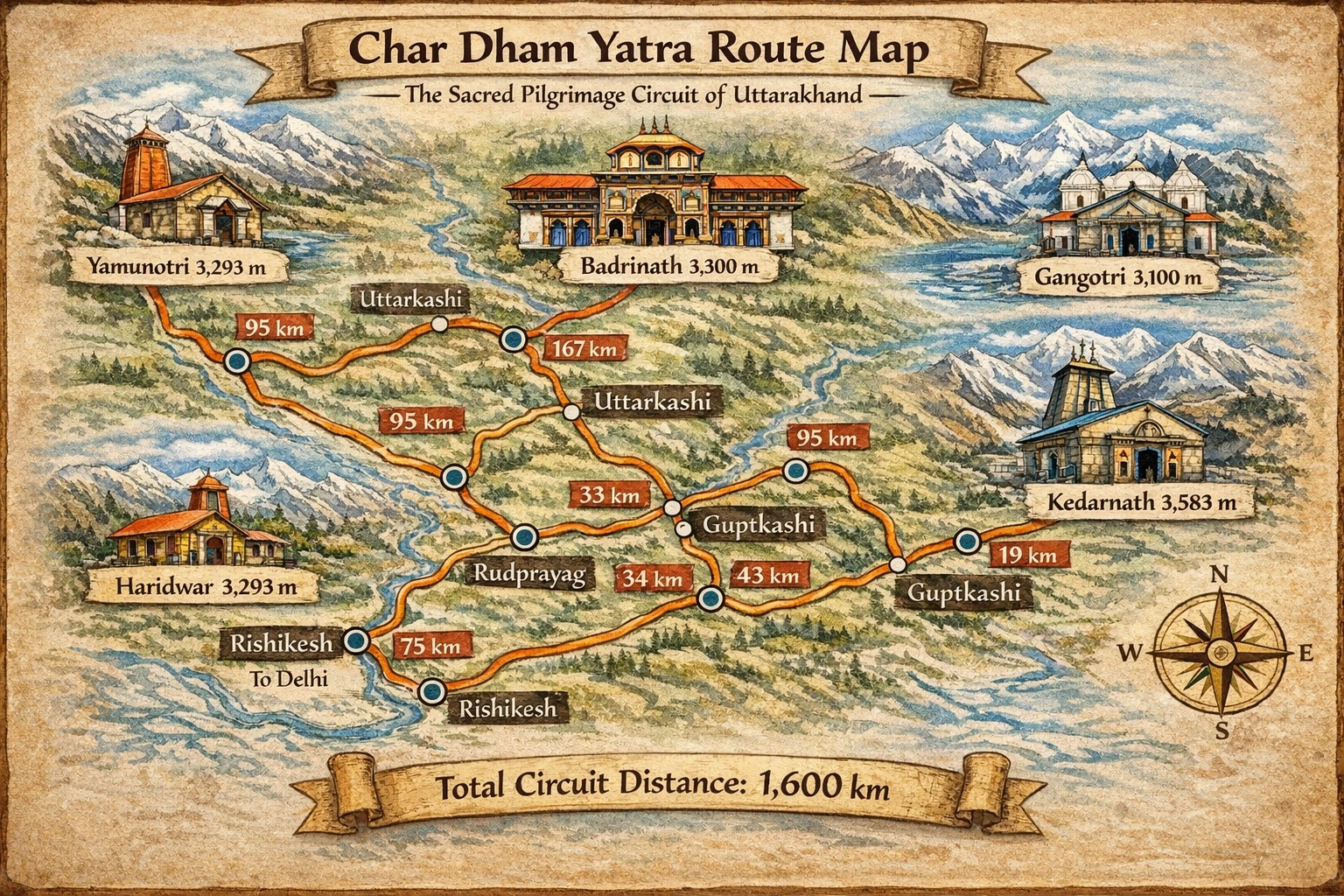
Complete Char Dham Yatra Itinerary from Haridwar (10-11 Days)
This comprehensive itinerary from Haridwar provides a balanced approach to the Char Dham Yatra, allowing sufficient time for both travel and spiritual experiences at each temple. This is the most popular starting point for the pilgrimage as Haridwar itself is a sacred city and offers excellent connectivity by road and rail.
Day 1: Haridwar to Barkot – Journey Begins
Distance: 220 km | Duration: 7-8 hours | Overnight: Barkot (1,220 m)
Your sacred journey begins in the holy city of Haridwar, where the Ganges descends from the mountains to the plains. After an early morning darshan at Har Ki Pauri, where pilgrims gather for the sacred Ganga Aarti, you’ll begin the road journey toward Barkot.
The drive takes you through Dehradun and along the Yamuna River valley, with the landscape gradually transforming from urban settlements to rural mountain villages. You’ll pass through Mussoorie, the “Queen of Hills,” before descending into the Yamuna valley. The route offers spectacular views of the Doon Valley and the surrounding mountains.
Barkot, a small town nestled in the Himalayas, serves as the base for your Yamunotri visit. Upon arrival, check into your hotel and rest. The evening is perfect for a walk through the local market, where you can interact with locals and feel the pulse of mountain life. The crisp mountain air and the distant sound of the Yamuna River create the perfect atmosphere for meditation and preparation for the pilgrimage ahead.
Travel Tip: Start early from Haridwar (by 6-7 AM) to avoid traffic and reach Barkot with daylight remaining. The roads are generally good but winding.
Day 2: Barkot to Yamunotri and Back – First Sacred Dham
Road Distance: Barkot to Janki Chatti 46 km | Trek Distance: 6 km one way | Overnight: Barkot
This is one of the most significant days of your pilgrimage. Rise before dawn and drive to Janki Chatti, the motorable road’s end point. The 46-kilometer drive takes you deeper into the mountains, following the Yamuna River as it narrows and becomes more turbulent.
From Janki Chatti, your 6-kilometer trek to Yamunotri temple begins. The well-maintained path ascends steadily through beautiful forests and alongside the rushing Yamuna. The trek is moderate but requires reasonable fitness, gaining approximately 500 meters in elevation. Along the way, you’ll pass numerous small shrines and resting points where chai and snacks are available.
As you approach the temple, the landscape opens up to reveal the stunning Bandarpunch peak (6,316 m) in the background. The Yamunotri temple itself is relatively small but powerfully sacred. The main attraction is the Divya Shila, a rock pillar worshipped before entering the temple, and the Surya Kund, where the water is hot enough to cook rice.
Participate in the temple rituals, take your holy dip (the water is hot from Surya Kund but there’s a separate bathing area where it cools), and offer your prayers to Goddess Yamuna. Many pilgrims cook rice in the hot spring as prasad. The atmosphere here is serene and deeply spiritual—devotees from across India gather here, their faces glowing with devotion and the exertion of the trek.
After darshan, descend back to Janki Chatti and return to Barkot for the night. The downhill trek is easier on the legs but requires caution on the sometimes slippery paths.
Trekking Tip: Start the trek early (by 6-7 AM from Janki Chatti) to avoid afternoon crowds and weather changes. Ponies and palanquins are available for those who prefer not to trek.
Day 3: Barkot to Uttarkashi – Gateway to Gangotri
Distance: 100 km | Duration: 4-5 hours | Overnight: Uttarkashi (1,150 m)
After breakfast, depart Barkot for Uttarkashi, an important town on the banks of the Bhagirathi River. The drive is scenic, passing through pine forests and alongside mountain streams. Uttarkashi, meaning “Kashi of the North,” is a significant religious center in its own right, often called the Varanasi of the Garhwal region.
Upon arrival, visit the Vishwanath Temple, dedicated to Lord Shiva, which bears architectural similarities to the famous Kashi Vishwanath Temple in Varanasi. The town is also home to several ashrams and the Nehru Institute of Mountaineering, India’s premier mountaineering training institution.
The evening is free to explore the riverside ghats where you can witness the evening aarti, shop for local woolens and religious items, or simply sit by the Bhagirathi River and absorb the spiritual energy of this sacred town. Uttarkashi has a more laid-back atmosphere compared to the more tourist-focused destinations, offering an authentic glimpse into Garhwal culture.
Local Experience: Try the local cuisine at small dhabas—simple but delicious mountain food prepared with local ingredients.
Day 4: Uttarkashi to Gangotri and Back – Source of the Holy Ganga
Distance: 100 km one way | Duration: 4-5 hours each way | Overnight: Uttarkashi
Today’s journey takes you to Gangotri, one of the most significant temples in the entire circuit. The 100-kilometer drive from Uttarkashi is breathtakingly beautiful but requires patience—the narrow mountain road winds along the Bhagirathi River, climbing steadily through dramatic gorges and past spectacular waterfalls.
You’ll cross several small villages and hamlets where life has changed little over centuries. The road passes through Gangnani, known for its hot water springs, and Harsil, a picturesque valley of apple orchards and wooden houses that seems frozen in time. Harsil was once the favorite summer retreat of Maharani Urmila Devi of Tehri, and its untouched beauty still captivates travelers.
Gangotri temple sits in a natural amphitheater of mountains, with the Bhagirathi River thundering past. The white granite temple gleams in the mountain sunlight, and the air resonates with the sound of temple bells and flowing water. The main deity is Goddess Ganga, depicted with four arms and holding a water pot and lotus, mounted on her vahana (vehicle), the crocodile.
The temple area is larger than Yamunotri, with several ghats along the river where devotees bathe before entering the temple. The Gangotri aarti, performed every evening as the sun sets behind the peaks, is a mesmerizing experience that fills the heart with devotion. The chanting, the flickering oil lamps, the mountain backdrop, and the roaring river create an atmosphere of profound spirituality.
After darshan and exploration of the area, return to Uttarkashi for the night. The return journey in the late afternoon offers different lighting on the mountains and valleys, making the same route look entirely new.
Extension Option: Trekkers can add 2-3 days to visit Gaumukh glacier (18 km from Gangotri), the actual source of the Ganges, though this requires additional permits and fitness.
Day 5: Uttarkashi to Guptkashi – Journey to Shiva's Realm
Distance: 220 km | Duration: 8-9 hours | Overnight: Guptkashi (1,319 m)
This is one of the longer driving days, so an early start is essential. The route takes you back from Uttarkashi toward the main highway, then eastward toward Guptkashi. You’ll pass through Chamba, a small town with beautiful temples, and Tehri, where the massive Tehri Dam creates one of India’s largest reservoirs.
The landscape changes as you travel—from the Bhagirathi valley to the Mandakini valley. The Alaknanda River and its tributaries are your constant companions, their jade-green waters cutting through deep gorges. You’ll cross several significant confluences (prayags), including Rudraprayag, where the Alaknanda and Mandakini rivers meet—a sacred confluence where pilgrims stop for rituals.
Guptkashi, your destination for the night, is a temple town dedicated to Lord Shiva. The name translates to “Hidden Kashi,” and according to legend, this is where Lord Shiva hid from the Pandavas before moving to Kedarnath. The town has two ancient temples—Vishwanath Temple and Ardhnareshwar Temple—both worth visiting in the evening.
The evening in Guptkashi is typically spent in preparation for the next day’s trek to Kedarnath. Many pilgrims visit the local temples, purchase offerings for Kedarnath, and mentally prepare themselves for the challenging trek ahead. The town has grown significantly to cater to pilgrims, with numerous hotels and shops selling everything from trekking gear to religious items.
Preparation Tip: Ensure you rest well tonight and pack a light overnight bag for Kedarnath, leaving unnecessary luggage in Guptkashi.
Day 6: Guptkashi to Gaurikund to Kedarnath – The Sacred Ascent
Road Distance: 30 km | Trek Distance: 16 km | Duration: Trek 6-8 hours | Overnight: Kedarnath (3,583 m)
Today marks the most physically demanding and spiritually significant leg of your journey. After an early breakfast, drive to Gaurikund (30 km, approximately 1-1.5 hours). Gaurikund itself is sacred, with a temple dedicated to Goddess Parvati (Gauri) and natural hot water springs where pilgrims bathe before beginning their ascent.
The 16-kilometer trek to Kedarnath is a test of faith and endurance. The path is well-maintained but steep in sections, gaining approximately 1,200 meters in elevation. The route passes through Rambara (about halfway), where basic refreshment facilities exist, and continues through varied terrain—forests, meadows, and rocky sections.
The trek is as much a spiritual journey as a physical one. You’ll be surrounded by fellow pilgrims, from elderly devotees being carried in palanquins to young families with children, all united in their devotion to Lord Shiva. The chants of “Jai Bhole Nath” and “Har Har Mahadev” echo through the valley, creating a moving atmosphere of collective faith.
As you gain altitude, the landscape opens up to reveal stunning mountain vistas. The Mandakini River roars in the valley below, and snow-capped peaks surround you. Finally, as you round a bend, the stone temple of Kedarnath comes into view, backed by the majestic Kedarnath peak (6,940 m). The sight of the temple after hours of climbing fills pilgrims with overwhelming emotion—many break down in tears at this first glimpse of Shiva’s abode.
Upon arrival in Kedarnath, check into your accommodation (book in advance during peak season), freshen up, and proceed to the temple. The Kedarnath temple, built from massive stone slabs without any mortar, has stood here for over a thousand years. The black stone idol of Lord Shiva in his bull form is the focus of worship, representing the hump that remained when Shiva disappeared into the earth.
The evening aarti at Kedarnath is an unforgettable experience. As darkness falls and the temperature drops, thousands of devotees gather in the courtyard, their breath visible in the cold air, their devotion warming the atmosphere. The chanting reverberates off the surrounding mountains, creating a natural amplification that makes you feel the entire valley is worshipping together.
Important Notes:
- Weather changes rapidly; carry warm clothing even in summer
- Altitude sickness can occur; ascend slowly and stay hydrated
- Temple opens around 4 AM for early morning aarti
- Helicopter services available from Phata/Sersi for those unable to trek
Day 7: Kedarnath to Gaurikund to Guptkashi – Descent and Reflection
Trek Distance: 16 km | Road Distance: 30 km | Overnight: Guptkashi
Wake before dawn for the morning aarti at Kedarnath temple—the ritual at sunrise is particularly special, with the first rays of sun touching the Kedarnath peak and bathing the temple in golden light. After final darshan and prayers, begin your descent to Gaurikund.
The downhill trek is easier on the cardiovascular system but can be tough on the knees. Take your time, use trekking poles if available, and watch your footing on the sometimes slippery path. Many pilgrims report that the descent offers time for reflection on their Kedarnath experience—the physical challenge overcome, the darshan received, and the transformation felt.
Upon reaching Gaurikund, drive back to Guptkashi. The rest of the day can be spent relaxing, recovering from the trek, and preparing for the next leg to Badrinath. Some pilgrims use this time to visit the Triyuginarayan Temple, about 25 km from Guptkashi, believed to be the site where Lord Shiva and Parvati were married. The temple has an eternal flame that has been burning since the wedding, according to legend.
Recovery Tip: Rest adequately, hydrate well, and consider a gentle massage to ease tired muscles.
Day 8: Guptkashi to Badrinath via Joshimath – The Final Dham
Distance: 245 km | Duration: 8-9 hours | Overnight: Badrinath (3,133 m)
This is another long driving day, but the route is spectacular. Leaving Guptkashi, you’ll travel through Rudraprayag and Chamoli, following the Alaknanda River upstream. The road passes through several significant pilgrimage sites and towns.
A key stop is Joshimath (also called Jyotirmath), approximately 45 km before Badrinath. This is one of the four cardinal peethams (monastic establishments) founded by Adi Shankaracharya. Joshimath is also where the idol of Lord Badrinath is brought down and worshipped during winter months when Badrinath temple closes due to heavy snow. The town has several ancient temples worth visiting, including the Narasimha Temple and the Shankaracharya Math.
From Joshimath, the road climbs toward Badrinath, passing through the spectacular Valley of Flowers region (though the actual Valley of Flowers requires a separate trek from Govindghat). The landscape is alpine, with steep mountains, hanging glaciers, and the Alaknanda River cutting through narrow gorges.
Badrinath, when you finally arrive, feels both grand and intimate. Unlike the remote isolation of Kedarnath, Badrinath is a bustling pilgrimage town with shops, restaurants, and numerous facilities. But the temple itself, set against the backdrop of Neelkanth Peak, radiates ancient sanctity.
After checking into your hotel, visit the temple in the evening. The Badrinath temple complex is larger and more elaborate than the other Char Dhams, with the main sanctum housing the black stone idol of Lord Badrinath (Vishnu) seated in meditation. Before entering the temple, pilgrims traditionally bathe in the Tapt Kund, natural hot springs right next to the temple.
The evening aarti at Badrinath is a grand affair, with elaborate rituals, musical instruments, and hundreds of devotees participating. The temple is brilliantly lit, and the energy is palpable—this is the culmination of the Char Dham circuit, and the joy and relief on pilgrims’ faces is evident.
Spiritual Practice: Many pilgrims perform shraddh (rituals for ancestors) at Brahma Kapal, a flat platform on the banks of the Alaknanda River near the temple.
Day 9: Badrinath Exploration and Mana Village – Touching the Border
Overnight: Badrinath
For those with time, spending a second day in Badrinath allows for deeper exploration. Start with an early morning darshan at the temple when it’s less crowded. Then visit the nearby sacred sites:
Mana Village (3 km from Badrinath): India’s last village before the Tibet border, Mana has retained its traditional character despite tourist influx. Visit Vyas Gufa (cave) where Ved Vyas composed the Mahabharata, and Ganesh Gufa where Ganesh wrote the epic. The Saraswati River emerges here from an underground tunnel, creating a beautiful spot called Keshav Prayag.
Vasudhara Falls: A 9 km trek from Badrinath leads to these stunning falls that cascade from 400 feet. According to legend, the water falls only on those who are pure of heart—impure souls remain dry even standing under the falls!
Charan Paduka: Located 3 km from Badrinath, this rock bears what is believed to be the footprints of Lord Vishnu. The views from here of the Neelkanth Peak are spectacular.
Satopanth Lake: For serious trekkers with 2-3 extra days, this glacial lake at 4,600 meters is considered the abode of the trinity—Brahma, Vishnu, and Mahesh (Shiva).
Return to Badrinath in the evening for a final aarti and to absorb the spiritual atmosphere of this sacred site one last time.
Local Tip: Try the local Garhwali cuisine—simple but delicious preparations of local grains, vegetables, and dairy products.
Day 10: Badrinath to Rudraprayag – Beginning the Return
Distance: 160 km | Duration: 5-6 hours | Overnight: Rudraprayag (610 m)
After morning darshan at Badrinath temple and final prayers, begin the return journey. The drive to Rudraprayag retraces your earlier route through Joshimath and along the Alaknanda River. With the pilgrimage essentially complete, this day often carries a different energy—a sense of accomplishment mixed with reluctance to leave these sacred mountains.
Rudraprayag, sitting at the confluence of the Alaknanda and Mandakini rivers, is a significant pilgrimage site itself. The Rudranath Temple here is dedicated to Lord Shiva in his Rudra (fierce) form. The evening can be spent walking along the confluence, witnessing the aarti, and reflecting on the journey.
Many pilgrims report that the return journey is when the full impact of the pilgrimage begins to sink in—the places visited, the devotion witnessed, the physical challenges overcome, and the spiritual experiences accumulated over the past days.
Day 11: Rudraprayag to Haridwar – Journey's End
Distance: 165 km | Duration: 5-6 hours
The final day of your Char Dham Yatra takes you back to Haridwar, where the pilgrimage began. The route descends from the mountains through Devprayag (confluence of Alaknanda and Bhagirathi, where the Ganges officially begins), Rishikesh, and finally to Haridwar.
Arriving in Haridwar, many pilgrims visit Har Ki Pauri once more to offer thanks for a safe and successful pilgrimage. The evening Ganga Aarti at Har Ki Pauri takes on new meaning after visiting the sources of the river high in the Himalayas—you’ve seen where the goddess dwells in her pure, powerful form, and now you see her blessing the plains and the millions who depend on her waters.
Final Thoughts: The Journey Beyond Distance
The Char Dham Yatra is measured in kilometers and days, but its true distance is the journey from doubt to faith, from worldly attachment to spiritual liberation. As you plan your itinerary, remember that while routes and schedules matter, the transformation happens not in reaching the temples, but in the journey itself—in the predawn awakening at Kedarnath, in the exhaustion overcome on the trek to Yamunotri, in the moment when you first see the Gangotri peaks, and in the peace that descends as you sit by the Alaknanda at Badrinath.
May your Char Dham Yatra bring you closer to the divine, strengthen your faith, and fill your heart with the eternal peace that these sacred mountains have offered pilgrims for millennia.
Har Har Gange! Jai Bhole Nath! Jai Badri Vishal!
Chardham Yatra Taxi Service
Frequently Asked Questions (FAQ)
How many days are required to visit Char Dham Yatra?
A complete Char Dham Yatra by road typically takes 10 to 12 days starting from Haridwar or Rishikesh. This duration allows for essential acclimatization and buffer time for unpredictable mountain weather or long darshan queues. If you are traveling by helicopter, the circuit can be condensed into 5 to 6 days.
How to complete Char Dham Yatra in 7 days?
Completing the full circuit in 7 days by road is extremely physically demanding and involves long driving hours (8-10 hours daily). To make it feasible: Day 1-2: Haridwar to Barkot and Yamunotri Darshan. Day 3-4: Barkot to Uttarkashi and Gangotri Darshan. Day 5-7: Head to Guptkashi/Sonprayag for Kedarnath (using a helicopter or pony to save time) and conclude with Badrinath before driving back. Pro Tip: For a 7-day window, most experts recommend choosing a Helicopter Package from Dehradun to ensure you don't miss any of the four shrines.
Which Chardham should I visit first?
Tradition dictates that the Yatra should be completed in a clockwise direction (Parikrama). Therefore, you should visit Yamunotri first, followed by Gangotri, then Kedarnath, and finally Badrinath. This sequence follows the path of the holy rivers from West to East.
What is the food like in Kedarnath?
Since Kedarnath is located at a high altitude (approx. 3,583m), the food is simple, vegetarian, and soul-warming. You will find: Standard Meals: North Indian staples like Dal-Chawal, Sabzi-Roti, and Parathas. Local Flavors: Garhwali dishes like Mandua ki Roti or Aloo ke Gutke are often available at local dhabas. Quick Energy: Maggi, tea, and coffee are available every few meters along the trek. Note: Alcohol and non-vegetarian food are strictly prohibited throughout the pilgrimage route.
What are the risks of Char Dham Yatra?
The primary risks include Acute Mountain Sickness (AMS) due to the high altitude, unpredictable weather causing landslides or cloudbursts, and physical exhaustion from the steep treks (especially the 16km Kedarnath route). Always check the latest weather updates and ensure you are registered on the Tourist Care Uttarakhand portal for emergency tracking.
How much is a taxi from Haridwar to Char Dham Yatra?
For a full 10-day circuit, taxi rates for 2026 generally start around: Sedan (Dzire/Etios): ₹35,000 – ₹45,000 SUV (Innova/Ertiga): ₹55,000 – ₹70,000 Tempo Traveller: ₹90,000 – ₹1,20,000 Note: Prices vary based on the season (May-June is peak) and include fuel, driver allowance, and tolls. Always confirm if "Hill Halt" charges are included.
Which is the nearest airport to Char Dham?
The nearest airport is Jolly Grant Airport (DED) in Dehradun. It is well-connected to major cities like Delhi, Mumbai, and Bangalore. From the airport, you can hire a taxi or take a bus to Haridwar or Rishikesh (approx. 20-30 km away) to begin your road journey, or head to the Sahastradhara Helipad for a helicopter tour.
Book Your Kathgodam to Nainital Taxi Now
Leave A Comment