
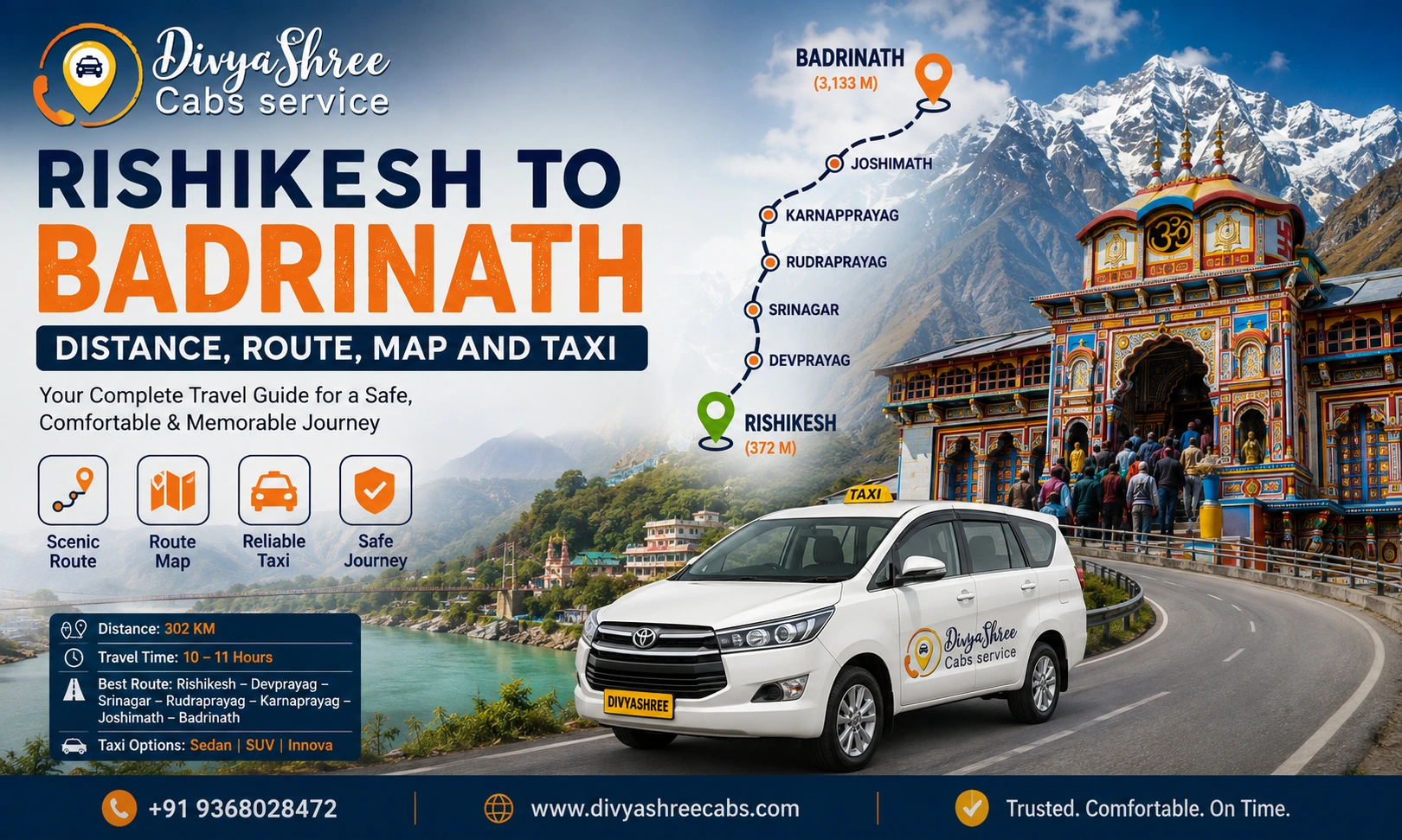
The Rishikesh to Badrinath distance by road is approximately 285–300 km, and the drive takes around 9 to 12 hours via Devprayag, Srinagar, Rudraprayag, Karnaprayag, and Joshimath. There's no direct train or flight to Badrinath — road is the only way in, and the highway (NH 7) goes right up to the temple parking, so no trekking is required. Buses run daily from Rishikesh, usually departing between 4 AM and 6 AM, while a private taxi offers more flexibility for the long journey. July and August (monsoon) are best avoided due to landslide risk; September to November and May to June are the more reliable windows.
Badrinath sits near the top of most Char Dham itineraries, and for good reason — it's one of the four sacred dhams, dedicated to Lord Vishnu, and unlike Kedarnath, it doesn't demand a trek to reach. The road goes directly to the temple. That doesn't make the journey short, though. At close to 300 km through some genuinely mountainous terrain, the drive from Rishikesh is a full day's commitment, and knowing what that day actually involves makes a real difference in how you plan it.
This guide walks through the complete route, current travel times, your options for getting there (taxi, bus, or a combination with rail), what the road conditions are actually like, and the practical questions people ask before committing to this trip — how difficult it really is, which month to pick, and what it costs either way you go.
One thing worth setting expectations on upfront: this isn't a trip you casually add to a weekend itinerary. Between the distance, the elevation change, and the fact that the road genuinely narrows in places, a Rishikesh to Badrinath journey deserves its own dedicated planning — ideally with at least one buffer day built in, whether that's for weather, an overnight stop partway, or simply not wanting to rush the last, most scenic stretch of the drive.
About Badrinath Temple
Badrinath is one of the four sacred Char Dham shrines and one of the 108 Divya Desams — temples considered particularly sacred within Vaishnavite tradition, dedicated to Lord Vishnu. Set on the banks of the Alaknanda river at 3,133 metres, its golden-roofed structure has been rebuilt and restored multiple times over the centuries following earthquakes and avalanches, yet the site has remained in continuous worship for well over a thousand years.
Unlike Kedarnath, which demands a trek through difficult terrain, Badrinath's relative accessibility by road has made it one of the more visited Char Dham shrines, drawing large numbers of pilgrims each season once the temple reopens after winter. Just beside the temple complex sits Tapt Kund, a natural hot spring believed to have healing properties — most pilgrims bathe here before entering for darshan, both as ritual practice and, frankly, as welcome relief after a long, cold journey.
A short distance beyond Badrinath lies Mana village, often described as the last Indian village before the Tibet border, and worth the extra drive if your schedule allows it. Local legend places several sites here from the Mahabharata, including Vyas Gufa (the cave where sage Ved Vyas is said to have composed the epic) and the dramatic Bheem Pul rock bridge across the Saraswati river — see our full guide to places to visit near Badrinath for more on these nearby stops.
Rishikesh to Badrinath Distance — The Numbers
Different sources quote slightly different figures for this route, mostly because the exact starting point within Rishikesh and small route variations add a few kilometers either way. In practice, the working range is 285–300 km, and most taxi operators and government bus schedules plan around a 9-to-12-hour journey.
| Metric | Detail |
|---|---|
| Road Distance | ~285–300 km |
| Aerial (straight-line) Distance | ~138 km |
| Road Travel Time | 9–12 hours |
| Elevation Gain | ~340 m (Rishikesh) to 3,133 m (Badrinath) |
| Joshimath to Badrinath (final stretch) | ~45 km, 1.5–2 hrs |
That elevation gain is worth pausing on — you're climbing nearly 2,800 metres over the course of the drive, which is part of why the journey takes as long as it does, and also why the temperature swing between Rishikesh and Badrinath can catch first-time travelers off guard.
The Route, Stage by Stage
The road follows NH 7 (formerly numbered NH 58) essentially the whole way, tracing the Alaknanda river valley through a sequence of towns that double as pilgrimage stops in their own right — the Panch Prayag, five sacred river confluences that mark the traditional route.
- 1Rishikesh → Devprayag~70 km. The confluence of the Bhagirathi and Alaknanda — officially where the Ganga begins.
- 2Devprayag → Srinagar (Garhwal)~35 km. A larger town along the valley, good for a fuel or food stop.
- 3Srinagar → Rudraprayag~35 km. Confluence of the Alaknanda and Mandakini rivers.
- 4Rudraprayag → Karnaprayag~35 km. Confluence of the Alaknanda and Pindar rivers.
- 5Karnaprayag → Chamoli → Joshimath~75 km. Longer stretch, climbing steadily toward higher elevation.
- 6Joshimath → Badrinath~45 km, 1.5–2 hrs. The final climb, often the most scenic and the most demanding stretch of driving.
📍 Note: "Panch Prayag" translates to the five sacred confluences — Devprayag, Rudraprayag, Karnaprayag, Nandprayag, and Vishnuprayag — several of which sit directly on this route. Many pilgrims treat the drive itself as part of the yatra rather than just transit time.
The character of the drive changes noticeably as you go. The first couple of hours out of Rishikesh feel almost like ordinary highway driving — wide roads, steady traffic, easy overtaking. That starts to shift around Devprayag, where the road begins hugging the river valley more closely, and by the time you're approaching Rudraprayag and Karnaprayag, you're firmly into proper hill driving: single-lane stretches, blind curves, and a pace dictated by the terrain rather than the speedometer. The final push from Joshimath to Badrinath is where most travelers say the scenery peaks — steep valleys, thinning tree cover, and, on a clear day, your first real glimpses of the high peaks surrounding Badrinath itself.
How Do I Go From Rishikesh to Badrinath?
Road is the only realistic option — there's no railway line into the mountains beyond Rishikesh, and no airport anywhere close to Badrinath itself. That leaves three practical choices: private taxi, state or private bus, or a shared jeep for part of the route. Each has a fairly different trade-off between cost, comfort, and flexibility.
By Taxi (Recommended)
A private taxi covers the full 285–300 km in a single day if you start early, typically 9 to 12 hours depending on traffic, weather, and how many stops you make along the Panch Prayag route. It's the most comfortable option by a wide margin, and the only one that lets you set your own pace — stopping at Devprayag or Rudraprayag without worrying about a bus schedule.
By Bus
UKSRTC (Uttarakhand state transport) and several private operators run daily buses from Rishikesh, generally departing between 4 AM and 6 AM to make the most of daylight hours on the mountain roads. It's considerably cheaper than a taxi, but slower, with fixed stops and less flexibility if you want to break the journey.
By Train
There's no direct train to Badrinath, and there never will be — the terrain simply doesn't support a rail line this deep into the Himalaya. Rishikesh Railway Station is the practical starting point for most pilgrims arriving from Delhi or elsewhere, well connected by regular services, with the rest of the journey completed entirely by road.
By Air
Jolly Grant Airport in Dehradun is the nearest airport, roughly similar in distance to Badrinath as Rishikesh itself. Flying in only shortens the initial leg from Delhi — it doesn't change the fact that the final 285–300 km still has to be covered by road.
How Much Is a Taxi From Rishikesh to Badrinath?
Fares scale with vehicle size, and — like most Char Dham routes — climb a little during peak season (May–June) when demand for hill vehicles peaks.
| Vehicle Type | One-Way Fare | Seating |
|---|---|---|
| Sedan (Dzire, Etios) | ₹6,500 – ₹8,000 | 4 passengers |
| Ertiga / SUV | ₹8,500 – ₹10,500 | 6 passengers |
| Innova Crysta | ₹10,500 – ₹13,000 | 7 passengers |
| Tempo Traveller | ₹15,000 – ₹19,000 | 10–12 passengers |
These are all-inclusive per-vehicle rates covering fuel, driver allowance, and tolls. If you're planning the full Do Dham route rather than Badrinath alone, our Kedarnath to Badrinath distance guide and Sonprayag to Badrinath taxi page cover that connecting leg.
Book Your Rishikesh to Badrinath Taxi
Fixed fares, hill-experienced drivers, and full support for the journey.
Choose Your Vehicle
Whichever suits your group, all our drivers on this route are locals who've made the drive many times over.




Fares are indicative and vary by season and availability — contact us for a confirmed quote.
Why Book Your Rishikesh to Badrinath Taxi With Us
A journey this long deserves a driver who actually knows the route, not just someone reading directions off a phone. Every driver we send on this route is a local who has made the Rishikesh-to-Badrinath run many times over, across every season — which matters more than it might sound, since knowing exactly which stretches to approach cautiously, where the reliable rest stops are, and how the road behaves differently in April versus September genuinely changes how comfortable the trip feels.
Our fares are quoted upfront and fixed — what we tell you before the trip is what you pay at the end, with no surprise additions for tolls, fuel, or "mountain surcharges" once you're already committed to the journey. Every vehicle in our fleet is regularly serviced and fully insured, and we scale the vehicle to your actual group size rather than pushing whatever's most readily available, whether that's a Sedan for a couple or a Tempo Traveller for a larger family gathering.
Beyond the vehicle itself, we're reachable throughout your journey — before you leave, during the drive if plans need to shift, and after you're dropped at Badrinath. For pilgrims planning to continue on to Kedarnath afterward, we also handle the connecting leg as part of a combined Do Dham booking, so you're not left arranging a second taxi from scratch partway through your trip.
Rishikesh to Badrinath Bus — Fare, Timing & Booking
Buses are the budget option on this route, and they run daily during the yatra season (roughly May through November, when Badrinath Temple is open). UKSRTC operates the main state-run service, alongside a handful of private operators covering the same corridor.
Timing
Most buses leave Rishikesh very early — typically between 4 AM and 6 AM — to make the most of daylight on the mountain stretches and to reach Badrinath before evening, since driving after dark on these roads is discouraged and, on some stretches, restricted outright.
Fare
Bus ticket prices are a fraction of a private taxi, usually a few hundred rupees per seat depending on the operator and whether it's a state or private service. Exact pricing shifts season to season, so it's worth confirming current rates directly with UKSRTC or at the Rishikesh bus stand before travel.
Booking
State buses can generally be booked at the Rishikesh ISBT counter, while several private operators also take bookings online or through local travel agents. During peak season (May–June), seats fill quickly, so booking a day or two ahead is a reasonable precaution rather than assuming a walk-up ticket will be available.
How Is the Road From Rishikesh to Badrinath? Is It Difficult to Reach?
The honest answer is: mostly good, with a few genuinely demanding stretches. NH 7 is a proper highway for much of the route through Devprayag and Srinagar, but it narrows and winds considerably past Rudraprayag, climbing through switchbacks toward Joshimath and the final approach to Badrinath. None of it is technically difficult to drive — it doesn't require any special skill beyond ordinary mountain driving — but it does demand patience, a driver who isn't rushing, and realistic expectations about how long each stretch will actually take.
Is Badrinath itself difficult to reach? Not in the way Kedarnath is — there's no trek involved, and the road goes directly to the temple parking area. What makes it feel demanding is simply the length of the drive and the altitude change, not any physical exertion once you arrive. Elderly travelers and those unused to long car journeys sometimes find the day itself tiring, which is why splitting the trip across two days — an overnight stop in Joshimath, for instance — is a common and sensible approach rather than attempting the full distance in one push.
Monsoon months (July–August) are where "difficult" becomes a more literal concern — heavy rain brings a real landslide risk on several stretches of this route, and road closures during this window aren't unusual. Outside of monsoon, the road is considered safe and manageable for an ordinary private vehicle with an experienced driver.
Where to Stay Along the Way
Given the length of this drive, plenty of pilgrims choose to break the journey rather than attempt it in a single 9-to-12-hour push — and there are a few sensible places to do that. Joshimath, roughly 45 km short of Badrinath, is by far the most popular overnight stop. It has a genuinely wide range of accommodation, from budget guesthouses to more comfortable hotels, and splitting the trip here means arriving at Badrinath fresh the next morning rather than exhausted after a full day on the road.
Rudraprayag and Srinagar (Garhwal) also have reasonable hotel options if you'd rather break the journey earlier, particularly useful if you're starting later in the day or traveling with elderly family members who need more frequent rest.
Badrinath itself has accommodation too, ranging from ashram-style dormitories to private hotels, though rooms fill up fast during peak season (May–June) and it's worth booking ahead rather than arriving and hoping. Many pilgrims stay one night in Badrinath itself to attend both evening and early-morning darshan, since the temple atmosphere shifts noticeably once the day-trip crowds thin out.
What to Pack for the Journey
The temperature swing on this route is significant — you're going from roughly 340 metres in Rishikesh to 3,133 metres in Badrinath, and it shows. Warm layers are non-negotiable regardless of season; even in peak summer, Badrinath evenings can be genuinely cold. A proper jacket, thermals, and a woolen cap are worth packing even if Rishikesh itself feels warm when you leave.
Beyond clothing, it's worth carrying basic altitude-related medication if you or anyone in your group is prone to headaches or breathlessness at elevation, along with a reusable water bottle — staying hydrated through the drive genuinely helps reduce mild altitude discomfort on arrival. A power bank is a practical addition too, since charging points can be inconsistent at guesthouses along the way, and mobile network coverage thins out noticeably past Joshimath.
If you're combining Badrinath with the Tapt Kund hot spring bath, pack a change of clothes and a towel specifically for that — most pilgrims bathe before entering the temple, and having dry clothes ready afterward makes a real difference given how cold Badrinath's air actually is compared to the warm spring water.
Rishikesh to Kedarnath to Badrinath — Combining Both Shrines
Many pilgrims don't stop at Badrinath alone — the Do Dham circuit, pairing Kedarnath and Badrinath in a single trip, is one of the most common itineraries out of Rishikesh. The two routes diverge at Rudraprayag: Kedarnath continues via Guptkashi and Sonprayag, while Badrinath continues via Karnaprayag and Joshimath.
A typical combined itinerary runs Rishikesh → Kedarnath (via Guptkashi/Sonprayag, with the 16–18 km trek to the temple) → back to Rudraprayag → onward to Badrinath via Joshimath, usually taking 6 to 8 days total depending on pace and rest days. This is considerably more demanding than a Badrinath-only trip, both in distance and in the physical trek required for Kedarnath, so it's worth planning generous buffer time rather than rushing between the two.
For the connecting leg specifically, see our Kedarnath to Badrinath distance guide, and for the broader combined package, our Do Dham taxi services and Kedarnath Badrinath tour package cover the full circuit.
Rishikesh vs. Haridwar — Which Should You Start From?
If you're arriving from Delhi or further afield, you'll likely land in either Haridwar or Rishikesh first, and it's a fair question which makes the better starting point for Badrinath. The short answer: Rishikesh saves you a little distance and time, since Haridwar sits roughly 25 km further back along the same road. The Haridwar to Badrinath distance runs closer to 320 km, against Rishikesh's 285–300 km, adding perhaps half an hour to 45 minutes to an already long day.
That said, the difference is modest enough that most travelers choose based on where they're already staying rather than optimizing purely for distance. Haridwar has somewhat stronger rail connectivity and a wider range of accommodation, which makes it the more practical base for many pilgrims arriving from outside Uttarakhand, even at the cost of a slightly longer drive. Rishikesh, meanwhile, appeals to travelers who want a day or two of yoga, the ghats, or river activities before beginning the yatra proper. Neither choice is wrong — it mostly comes down to your itinerary before the yatra begins.
What to Expect During Darshan
Badrinath Temple typically opens for darshan early in the morning, with timings shifting slightly depending on the season and any special rituals scheduled that day. During peak season (May–June), queues can run long, particularly in the mid-morning hours once day-trippers arrive from Joshimath and beyond — arriving for the early morning slot, or alternatively for evening aarti, generally means a shorter wait and a calmer atmosphere overall.
Most pilgrims bathe at Tapt Kund before entering, both as ritual practice and simply because the hot spring water is a welcome contrast to Badrinath's cold mountain air. Modest clothing is expected inside the temple complex, and photography restrictions apply in certain areas, so it's worth checking current rules on arrival rather than assuming.
For pilgrims wanting a less rushed experience, staying overnight in Badrinath itself — rather than doing a same-day round trip from Joshimath — genuinely changes the visit. The temple town empties out considerably once day-trip crowds head back down in the late afternoon, and an early morning or late evening darshan in that quieter window tends to be the most memorable part of the whole trip for a lot of travelers.
Which Month Is Best for Badrinath?
May to June marks the opening of the season, with pleasant weather and clear mountain views — though it's also the busiest window, coinciding with the temple's reopening and school summer holidays.
July and August are best avoided if you have flexibility. Monsoon rain brings a genuine landslide risk to several stretches of this route, and delays or road closures aren't uncommon.
September to November is widely considered the better overall window — post-monsoon clarity, thinner crowds than the May–June rush, and generally stable road conditions right up until the temple closes for winter (typically around late October or November, based on the Hindu calendar).
Outside this roughly six-month window, Badrinath Temple closes entirely due to heavy snowfall, and the road itself becomes impassable in the higher stretches — so travel is only possible within the open yatra season.
Registration & Documents You'll Need
Char Dham Yatra registration — commonly known as the e-Pass or biometric registration — is typically required each season before you travel to Badrinath. This isn't unique to Badrinath specifically; it applies across the Char Dham circuit and is designed to help authorities track pilgrim numbers and manage crowding at the shrines, particularly during peak weeks.
Registration is generally done online in advance, though on-the-spot registration counters do exist at key points along the route for travelers who haven't pre-registered. It's considerably less stressful to sort this out before you leave rather than at a checkpoint with a queue behind you, so building it into your pre-trip planning is worth the small extra effort. For commercial vehicles making this trip, there's also a separate Green Card requirement — see our Green Card for Char Dham Yatra guide for what that involves.
Beyond the yatra registration itself, carrying a government-issued photo ID is standard practice for verification at checkpoints along the route, and it's worth keeping both a physical and digital copy in case one gets misplaced during a long, multi-day trip.
Health & Altitude Considerations
At 3,133 metres, Badrinath sits high enough that altitude genuinely affects some travelers, even though the journey itself is entirely by road rather than trek. Mild symptoms — headache, slight breathlessness, difficulty sleeping the first night — aren't unusual and typically resolve within a day as your body adjusts. Staying well hydrated throughout the drive is the single most effective thing you can do to reduce the likelihood of this.
Travelers with pre-existing heart or respiratory conditions, or those simply unused to elevation, should consider a conversation with a doctor before the trip — not because Badrinath is unusually risky, but because altitude affects people differently and it's better to know your own limits in advance rather than discover them on arrival. Elderly pilgrims in particular benefit from the two-day approach mentioned earlier, breaking the journey at Joshimath rather than pushing through in a single long day, since fatigue compounds the effects of altitude.
It's also worth noting that basic medical facilities exist at Badrinath itself during the yatra season, but they're limited compared to what you'd find in a city — carrying any personal prescription medication you need, rather than assuming it'll be available locally, is a sensible precaution.
Frequently Asked Questions
-
By road — there's no train or flight option. A private taxi or bus covers the 285–300 km via Devprayag, Rudraprayag, Karnaprayag, and Joshimath, taking 9 to 12 hours. The road goes directly to the temple, so no trekking is required. Many pilgrims split the journey with an overnight stop in Joshimath rather than attempting it in a single day.
-
Mostly good — a proper highway through Devprayag and Srinagar, narrowing and winding more past Rudraprayag toward Joshimath. It's manageable for an ordinary car with an experienced driver, though it demands patience given the mountain terrain and the sheer length of the drive.
-
Not physically — unlike Kedarnath, there's no trek, and the road reaches the temple directly. The main challenge is simply the length of the drive and the altitude change, which is why splitting the trip over two days, with an overnight stop at Joshimath, is a common and sensible approach.
-
Generally well-maintained, though narrower and winding past Rudraprayag. Monsoon months (July–August) bring a real landslide risk on some stretches, so it's worth checking current road conditions if traveling during that window.
-
September to November is generally the best window — clear post-monsoon skies and thinner crowds than the May–June rush. May–June is also good weather-wise but noticeably busier. July–August (monsoon) is best avoided due to landslide risk on the route.
-
A one-way taxi costs approximately ₹6,500–₹8,000 for a Sedan, ₹8,500–₹10,500 for an Ertiga, ₹10,500–₹13,000 for an Innova Crysta, and ₹15,000–₹19,000 for a Tempo Traveller. Prices rise somewhat during peak season (May–June).
-
Bus fare is a fraction of a private taxi, typically a few hundred rupees per seat, though exact pricing varies by operator and season. UKSRTC and private buses generally depart between 4 AM and 6 AM to make the most of daylight on the mountain roads.
Planning Your Journey With Confidence
A trip from Rishikesh to Badrinath is, in the end, a fairly straightforward drive made to feel bigger by its length and altitude rather than any real technical difficulty. The road is good, the route is well-traveled by hill-experienced drivers who make this run regularly, and the destination — a temple that's drawn pilgrims for over a thousand years, set against genuinely dramatic Himalayan scenery — rewards the effort in full.
Whether you're planning a focused round trip or folding Badrinath into a longer Do Dham circuit with Kedarnath, the fundamentals stay the same: book your transport ahead of peak-season dates, complete your yatra registration before you leave rather than at a checkpoint, pack for genuinely cold evenings even in summer, and give yourself an honest buffer day rather than assuming everything will go exactly to schedule. Get those basics right, and the rest of the journey tends to take care of itself.
Ready to Book Your Rishikesh to Badrinath Cab?
Fixed fares, experienced hill drivers, and full support for the full journey to Badrinath.
Leave A Comment