
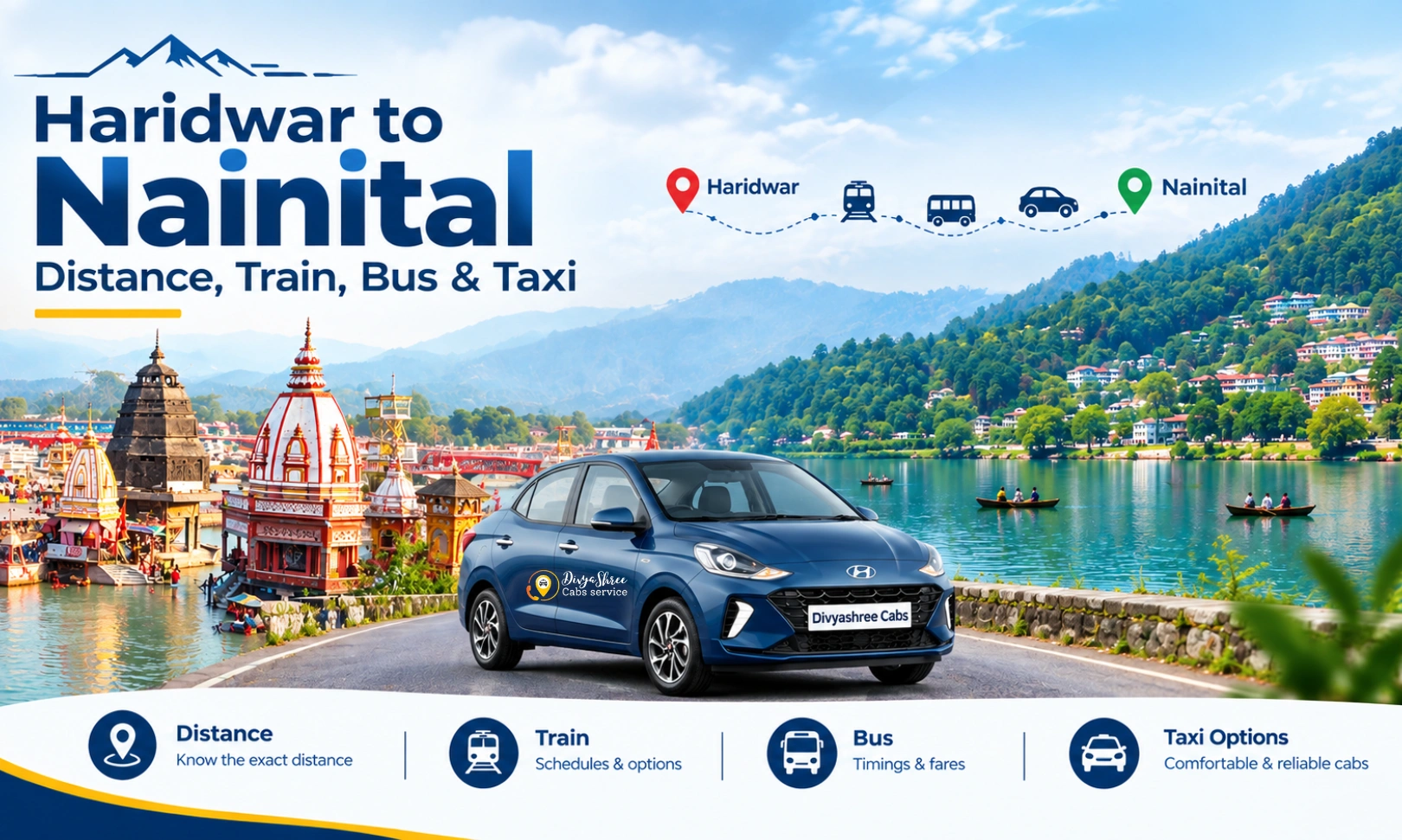
The Haridwar to Nainital distance is approximately 215 to 235 km by road, and the drive takes around 6 to 7 hours via Najibabad, Kashipur, Haldwani, and Bhowali. This is a Terai-plains route, not the Garhwal mountain corridor used for Char Dham — mostly flat highway until the final climb past Bhowali into Nainital itself. There's no direct train to Nainital; the nearest railway station is Kathgodam, about 35 km away. A private taxi remains the most convenient option, with a Sedan being the cheapest vehicle choice for solo travelers or couples.
Nainital remains the most visited hill station in the Kumaon region, built around its namesake lake and busy mall road, and for travelers based in Haridwar, it makes for a genuinely comfortable long-day trip or a relaxed overnight getaway. Unlike the mountain routes toward Kedarnath or Badrinath, the road to Nainital runs mostly through flat Terai plains before climbing in its final stretch — a noticeably different, easier kind of drive.
This guide covers the complete Haridwar to Nainital distance by road, the full route, transport options including train and bus alternatives, current taxi fares, and the practical questions travelers ask most — how far Nainital sits from Rishikesh and Mussoorie, whether you can reach it by train, and how far Kainchi Dham is from Haridwar for those combining both stops.
One thing worth understanding upfront: this journey behaves differently from most Uttarakhand trips people plan around Haridwar. The majority of routes out of Haridwar head north into the Garhwal Himalaya — Kedarnath, Badrinath, Mussoorie, the Char Dham circuit — and involve mountain roads from fairly early on. Nainital sits in the opposite direction, in the Kumaon region to the east, and the route there crosses flat agricultural plains for most of its length before climbing only in the final stretch. That changes everything about how the drive feels, how long it takes relative to the distance, and what kind of vehicle makes sense.
About Nainital
Nainital takes its name from Naini Lake, the pear-shaped body of water at its centre, and from Naina Devi — the goddess whose temple sits at the lake's northern edge. In Hindu tradition, the lake is associated with one of the Shakti Peethas, believed to mark where the eyes of the goddess Sati fell, which is where the name "Naini" (eyes) originates. That religious significance sits alongside the town's more recent history as a British-era hill station, developed from the 1840s onward as a summer retreat from the heat of the plains.
That dual character is still visible today. The colonial-era architecture around the mall road and the older churches sit alongside temples and ghats, and the town functions simultaneously as a pilgrimage destination and a straightforward holiday hill station. For most visitors arriving from Haridwar, it's the latter that dominates — boating on the lake, walking the mall road, taking the ropeway up for the view, and generally enjoying a cooler climate than the plains offer.
Nainital sits at roughly 2,084 metres, which is high enough for genuinely cool weather but nowhere near the altitudes that create acclimatization concerns on Char Dham routes. This is one of the reasons it works so well as a family destination — elderly travelers and young children generally handle the elevation without difficulty, unlike destinations such as Kedarnath or Badrinath where altitude is a real planning factor.
Understanding the Terai Route
The Terai is a distinct geographic band running along the southern edge of the Himalayan foothills — a belt of fertile, historically marshy lowland sitting between the mountains proper and the wider Gangetic plain. Almost the entire Haridwar-to-Nainital drive crosses this zone, which explains why the terrain stays flat and the road stays wide for so much of the journey.
This geography has practical consequences beyond just making for an easier drive. The Terai's agricultural land supports a string of market towns along this route — Najibabad, Kashipur, Rudrapur — each with its own local economy built around farming, sugar mills, and trade. That's part of why traffic through these stretches can be unpredictable even though the road surface itself is generally good: you're passing through working towns rather than tourist corridors, and local commercial traffic operates on its own rhythms.
It also explains why the final 35 km from Haldwani onward feels so different. That's the point where the Terai ends and the Kumaon foothills begin, and the road transitions from flat highway to genuine hill driving within a fairly short distance. Travelers who've spent five hours on level road sometimes find this last stretch more tiring than expected, simply because the driving demands change so abruptly.
Haridwar to Nainital Distance — The Basics
Different route calculators and travel sites quote slightly different figures for this trip, generally landing somewhere between 215 and 235 km depending on the exact path taken through the Terai belt. The journey typically takes 6 to 7 hours by car.
| Route | Distance | Travel Time |
|---|---|---|
| Haridwar to Nainital | ~215–235 km | 6–7 hrs |
| Nainital to Haridwar (return) | ~215–235 km | 6–7 hrs |
| Rishikesh to Nainital | ~225–250 km | 6.5–7.5 hrs |
| Mussoorie to Nainital | ~355 km | 9–10 hrs |
| Haldwani to Nainital (final stretch) | ~35 km | ~1–1.5 hrs |
| Bhowali to Nainital | ~11 km | 20–25 min |
📍 Note: This route is entirely different from the roads used for Kedarnath or Badrinath. Rather than heading north through Rishikesh and Devprayag into the Garhwal Himalaya, the Nainital route runs east across the Terai plains toward Kumaon, only turning into genuine hill driving in the final stretch past Haldwani and Bhowali.
Haridwar to Nainital Route Map — Stage by Stage
The standard route crosses UP border territory briefly before looping back into Uttarakhand, following NH 74 for much of the distance.
- 1Haridwar → Najibabad~55–65 km · Flat highway, crossing briefly into Uttar Pradesh
- 2Najibabad → Kashipur~85–90 km · Terai plains driving, generally easy going
- 3Kashipur → Rudrapur → Haldwani~65–70 km · Passing through Rudrapur's industrial belt
- 4Haldwani → Kathgodam → Bhowali~28 km · Where the hill road properly begins
- 5Bhowali → Nainital~11 km · Final short climb into the hill station itself
The overwhelming majority of this drive — roughly 200 km of it — is flat or gently rolling highway. Only the last 35 to 40 km, from Haldwani onward, involves any real hill driving, which is part of why this route feels noticeably less demanding than most other Uttarakhand journeys of similar distance.
Road Conditions on This Route
The road quality on the Haridwar-to-Nainital corridor is generally good throughout. The stretch through Najibabad and on toward Kashipur is standard national highway — wide, well-surfaced, and fast-moving outside of local town traffic. The middle section crossing Kashipur and Rudrapur runs through flat agricultural country with occasional slow stretches through market areas, but nothing that demands particular caution from a driving standpoint.
The final section from Haldwani through Bhowali to Nainital is where actual hill driving begins — a steady climb with proper curves, though nothing approaching the severity of Garhwal's Char Dham routes. There are no single-lane sections clinging to cliff edges here, no hairpin sequences that demand real experience. For most drivers, it's a manageable climb that simply requires slowing down and paying attention.
The variable that most affects travel time isn't terrain, it's traffic. The built-up stretches around Haridwar's exit, Najibabad, Kashipur, and Rudrapur can slow things considerably during daytime hours when local commercial traffic peaks. An early morning departure — leaving Haridwar by 6 or 7 AM — reliably avoids the worst of this and typically means arriving in Nainital with daylight to spare rather than navigating the final hill climb after dark.
Monsoon months (July and August) warrant some caution, though less than routes further into the mountains. The Terai stretches can see waterlogging during heavy rain, and the final climb past Bhowali can experience reduced visibility during downpours. Landslide risk exists but is considerably lower here than on Garhwal's steeper hill roads.

A Different Kind of Uttarakhand Drive
If you've driven the Char Dham routes before, the road to Nainital will feel like a different experience entirely. There's no altitude sickness to plan around, no narrow single-lane hill stretches for most of the journey, and no landslide-prone monsoon corridor to navigate. The trade-off is simply distance — at 215 to 235 km, it's a genuinely long single-day drive, even if the roads themselves are comparatively easy.
How Do I Go From Haridwar to Nainital?
By Taxi (Recommended)
A private taxi covers the 215–235 km in 6 to 7 hours, and given how much of the route is flat highway, it's a genuinely comfortable drive compared to most Uttarakhand hill routes. This is the most flexible option, letting you set your own pace and stop wherever suits you along the way.
By Bus
Direct buses run between Haridwar and Nainital, with services departing regularly and the journey generally taking 6 to 7 hours. This is a solid budget option, though seating comfort and exact timing vary by operator. Both state transport and private operators run this corridor, with private services generally offering somewhat better seating at a higher fare. Overnight services exist on some schedules, which appeals to travelers wanting to avoid losing a full day to the drive, though arriving in a hill town in the early morning hours has its own practical drawbacks around check-in timing.
How Do I Get From Haridwar to Nainital by Train? Can We Go to Nainital by Train?
Not directly — there's no railway line into Nainital itself, since the hill town's terrain doesn't support track construction that high. The nearest railway station is Kathgodam, roughly 35 km away, which functions as the railhead for this entire part of Kumaon. Several trains run daily from Haridwar to Kathgodam, after which a taxi or shared jeep covers the remaining short stretch through Bhowali into Nainital. If train travel is your preference, this two-stage approach (train to Kathgodam, then road) is the standard way to do it.
Kathgodam's significance here is worth understanding: it's genuinely the end of the line, the northernmost station in this part of Uttarakhand, beyond which the terrain rules out further rail construction entirely. Every train journey into the Nainital area terminates there, which is why it's referenced so consistently in travel planning for this region despite being a relatively small station. Taxis and shared jeeps wait outside the station specifically to handle onward transfers, so connecting onward isn't difficult — it just requires factoring the extra leg into your timing.
Haridwar to Nainital Taxi Cost
Fares scale with vehicle size, and — as with most Uttarakhand routes — tend to rise somewhat during peak season (April–June and October) when demand for hill-bound vehicles is highest.
| Vehicle Type | One-Way Fare | Seating |
|---|---|---|
| Sedan (Dzire, Etios) | ₹6,000 – ₹7,500 | 4 passengers |
| Ertiga / SUV | ₹7,800 – ₹9,500 | 6 passengers |
| Innova Crysta | ₹9,500 – ₹11,500 | 7 passengers |
| Tempo Traveller | ₹13,000 – ₹16,500 | 10–12 passengers |
Which Cab Is the Cheapest?
A Sedan is the most economical choice for this route, generally running ₹6,000 to ₹7,500 one-way — the right fit for solo travelers or couples without much luggage. For families or small groups, splitting an Ertiga's fare often works out cheaper per person than two Sedans, so it's worth comparing based on your actual group size rather than defaulting to the smallest vehicle.
Book Your Haridwar to Nainital Taxi
Fixed fares, comfortable vehicles, and reliable drivers for the journey to Nainital.
Choose Your Vehicle
Whichever vehicle suits your group, all our drivers on this route are comfortable with both the long highway stretch and the final hill climb into Nainital.




Fares are indicative and vary by season and availability — contact us for a confirmed quote.
Choosing the Right Vehicle for Your Group
Because this route is mostly flat highway rather than sustained mountain driving, vehicle choice affects cost more than it affects comfort — though the six-to-seven-hour duration means space still matters more than it would on a short hop.
For solo travelers and couples, a Sedan is the obvious choice. It handles the highway stretch comfortably, manages the final hill climb without difficulty, and keeps costs at their lowest. The main limitation is luggage space, which becomes relevant if you're carrying winter clothing for a cold-season Nainital trip.
Families of four to six generally find an Ertiga or Innova the better fit. The extra room matters across a journey this long, and the cost difference per person shrinks considerably once you're splitting the fare across more travelers. An Innova in particular tends to be the choice for families with elderly members, given its higher seating position and smoother ride quality on the final hill section.
For larger groups — extended families, friend groups, or anyone traveling in a party of eight or more — a Tempo Traveller almost always works out more economical than running two separate cars, and it keeps everyone together rather than arriving in staggered batches. It's also the practical choice if your Nainital trip is part of a broader Kumaon circuit involving multiple stops, since the additional luggage capacity genuinely helps.
How Far Is Rishikesh From Nainital?
Rishikesh to Nainital covers approximately 225 to 250 km, taking around 6.5 to 7.5 hours by road — slightly longer than the Haridwar route, since Rishikesh sits marginally further from the Terai corridor that most of this journey follows. The route itself converges with the Haridwar path fairly early on, running through the same Najibabad-Kashipur-Haldwani-Bhowali sequence for the majority of the distance.
For travelers deciding between Haridwar and Rishikesh as a starting point, the difference is modest enough that it rarely drives the decision on its own. Haridwar has somewhat stronger rail connectivity from across India, which makes it the more practical arrival point for many travelers coming from outside Uttarakhand. Rishikesh appeals to those wanting a day or two of yoga, riverside time, or adventure activities before heading into the hills. Either works well; the extra half-hour or so of driving from Rishikesh is unlikely to be the deciding factor for most itineraries.
How Far Is Mussoorie From Nainital?
Mussoorie to Nainital is a considerably longer trip — approximately 355 km, taking 9 to 10 hours by road. This makes sense once you consider the geography: Mussoorie sits in the Garhwal Himalaya near Dehradun, while Nainital belongs to the separate Kumaon region further east, and there's no shortcut between the two that avoids descending back to the plains and crossing the Terai belt in between. Travelers wanting to see both regions in one trip generally treat them as two distinct legs of a longer Uttarakhand itinerary rather than a single continuous drive.
If both hill stations are on your list, a common approach is to break the journey with a night in Haridwar, Rishikesh, or Kashipur rather than attempting the full 355 km in one push — which makes for a genuinely tiring day given the hill driving at both ends.
How Far Is Neem Karoli From Haridwar? (Haridwar to Kainchi Dham)
Kainchi Dham — the ashram associated with Neem Karoli Baba — sits approximately 200 to 215 km from Haridwar, roughly 20 km before Nainital along essentially the same route. Since it's positioned just off the main Haldwani-Bhowali corridor, many travelers combine a Kainchi Dham visit with their Nainital trip rather than treating it as a separate journey. See our dedicated Haridwar to Kainchi Dham distance guide for the full route breakdown and current taxi fares for that specific leg.
The ashram itself takes its name from the scissor-like bend in the road at that point in the valley — "kainchi" meaning scissors in Hindi. Established in 1964, it has grown into one of the most visited spiritual sites in Kumaon, drawing a genuinely mixed crowd of lifelong devotees, first-time visitors, and travelers who simply heard about it somewhere and wanted to see it. Most visits take between 30 minutes and an hour, which makes it easy to fit into your arrival day without disrupting the rest of your itinerary.
Practically speaking, visiting Kainchi Dham on the way to Nainital works better than treating it as a day trip from Nainital afterward, since it sits directly on the inbound route. Doing it as a separate excursion later means covering the same 20 km stretch twice unnecessarily.
What Is the Closest City to Nainital?
Haldwani is the closest significant city to Nainital, roughly 35 km away — the commercial and administrative hub of the wider Kumaon region, and the natural staging point for trips heading up into the hills. Bhowali, an even smaller town just 11 km from Nainital, sits closer still, though it's more of a small market town than a proper city. For most practical purposes — hospitals, larger markets, better accommodation variety — Haldwani is the answer most travelers are actually looking for.
Haldwani's role goes beyond just proximity. It's where the plains genuinely end and the Kumaon foothills begin, historically serving as the trading point where hill produce came down to meet plains markets. For travelers, that translates into practical usefulness: it's the last place on this route with reliable ATMs, larger pharmacies, well-stocked shops, and a full range of vehicle services before the road starts climbing.
Best Time to Visit Nainital
March to June brings pleasant weather, ideal for most travel plans, though April through June also coincides with peak tourist season and summer school holidays, meaning heavier crowds and higher accommodation prices. September to November offers clear post-monsoon skies and noticeably thinner crowds, making it a strong alternative for travelers who'd rather avoid the peak rush. December to February brings cold, sometimes snowy conditions — appealing if you specifically want a winter hill-station experience, though warm clothing is essential. July and August (monsoon) are generally best avoided given landslide risk on parts of the route and reduced visibility in the hills.
A Closer Look at Each Season
March and early April sit in a genuinely good window — temperatures are warming but the summer rush hasn't fully arrived, and accommodation rates remain more reasonable than they will be by May. Daytime weather is comfortable for walking the mall road and boating without the crowds that define peak season.
May and June represent peak season proper. Nainital fills up substantially, particularly on weekends, as families escape the heat of the plains. Book accommodation well in advance during this window, and expect the mall road and boating areas to be genuinely busy. The upside is reliably pleasant weather and a lively atmosphere.
September and October are arguably the best overall window for travelers with flexibility. The monsoon has cleared, visibility of the surrounding hills is at its best, and crowd levels drop off considerably from the summer peak. Temperatures remain comfortable for daytime activity while evenings turn pleasantly cool.
November through February brings cold weather and occasional snowfall at higher points around the town. This appeals specifically to travelers wanting a winter experience — and Nainital does look genuinely striking under snow — but it requires proper warm clothing, and some activities scale back during the coldest weeks.
What to See in Nainital
Naini Lake sits at the heart of the town, with boating a standard first activity for most visitors, alongside a walk along the busy mall road that runs beside it. The Naina Devi Temple, located at the northern edge of the lake, draws a steady stream of pilgrims alongside tourists. For wider views, the ropeway up to Snow View Point offers a genuinely impressive panorama of the surrounding peaks on clear days.
Beyond the town itself, Bhimtal and Naukuchiatal — two quieter lake towns nearby — offer a more relaxed alternative for travelers wanting Kumaon's lake-district scenery without Nainital's peak-season crowds, both easily reachable as short day trips from Nainital.
Within Nainital itself, a few other stops round out a typical visit. Tiffin Top (also called Dorothy's Seat) offers a panoramic viewpoint reachable by a short walk or pony ride. The Nainital Zoo, officially the Pt. G.B. Pant High Altitude Zoo, houses Himalayan species including snow leopards and Himalayan black bears. Eco Cave Gardens, a network of small interconnected caves, tends to appeal particularly to families traveling with children. And St. John in the Wilderness, a colonial-era church a short distance from the mall road, is worth a stop for anyone interested in the town's British-era history.
Extending Your Trip — The Wider Kumaon Circuit
Nainital works well as a standalone destination, but it also functions as an effective base for exploring the broader Kumaon region, which gets considerably less attention than Garhwal despite having plenty worth seeing.
Kainchi Dham
Roughly 20 km from Nainital along the Bhowali-Almora road, the ashram associated with Neem Karoli Baba has become a significant destination in its own right — drawing both religious pilgrims and travelers curious about its well-documented association with several prominent figures from the technology world. Given its position directly on the route between Haldwani and Nainital, it's easily combined with your arrival or departure rather than requiring a separate trip.
Jim Corbett National Park
India's oldest national park sits roughly 65 km from Nainital via Kaladhungi or Ramnagar, making a Nainital-plus-Corbett itinerary one of the more common ways travelers structure a longer Kumaon trip. Safari bookings typically need arranging in advance, particularly for the more popular zones during peak season, so it's worth sorting that out before you leave rather than assuming availability on arrival.
Mukteshwar and Ranikhet
Both sit further into the hills and offer a quieter, less commercial alternative to Nainital itself. Mukteshwar is known for its orchards and viewpoints, while Ranikhet — a cantonment town — has a notably relaxed pace and pine-forested surroundings. Neither works as a same-day trip from Haridwar, but both are comfortable additions to a multi-day Kumaon itinerary based out of Nainital.
Almora
One of Kumaon's oldest hill towns, Almora is known for its traditional architecture, local markets, and its role as a gateway toward treks further into the high Himalaya. It sits roughly three hours beyond Nainital, making it better suited to travelers with a week or more rather than a long weekend.
Where to Stay
Nainital offers accommodation across every price range, from budget guesthouses to more upscale lakeside hotels, though availability tightens considerably during peak season (April–June) and around major weekends. Booking ahead is genuinely worth doing if your travel dates fall within these busier windows, since last-minute options during peak season are both limited and considerably more expensive than booking in advance.
It's also worth knowing that Nainital restricts vehicle movement in parts of the town centre during peak season, and parking near the mall road can be genuinely difficult. Hotels further from the lake often have easier parking but require more walking to reach the main attractions — a tradeoff worth considering when booking, particularly if you're traveling with elderly family members or young children.
Practical Tips for the Journey
Leave early. This is the single most useful piece of advice for this particular route — a 6 or 7 AM departure from Haridwar clears the busier stretches around Najibabad and Kashipur before local traffic builds, and it means arriving in Nainital with daylight remaining rather than tackling the Bhowali climb in the dark.
Carry cash in smaller denominations for tolls and roadside stops. While the larger towns along this route have digital payment widely available, smaller dhabas and local vendors don't always, and toll booths move faster with exact change.
Fuel up before the final climb. Haldwani is the last reliable place to find fuel stations with consistent availability before the road climbs toward Bhowali and Nainital — worth topping up there rather than assuming you'll find options further up.
Pack warm layers regardless of season. Even during summer months, Nainital evenings turn noticeably cool given the elevation, and travelers arriving from the warm plains are sometimes caught off guard. A light jacket suffices for most of the year; proper winter clothing is essential from November onward.
If Kainchi Dham is part of your plans, factor it into your timing rather than treating it as a spontaneous stop. The ashram sits directly on the route, and visiting it on the way to Nainital rather than as a separate trip from Nainital saves genuine backtracking.
Why Book Your Haridwar to Nainital Taxi With Us
Even though this route is largely flat highway, having a driver who knows the corridor well still matters — particularly through the busier stretches around Kashipur and Rudrapur, and the final hill climb past Bhowali where local knowledge of traffic patterns and timing genuinely helps. Every driver we send on this route makes the run regularly.
Our fares are quoted upfront and fixed, with every vehicle in our fleet regularly serviced and fully insured. Whether Nainital is your main destination or you're combining it with a stop at Kainchi Dham, we scale the vehicle to your group size and stay reachable throughout your journey. If your broader Uttarakhand plans also include the Garhwal side of the state, see our guides to Haridwar to Mussoorie distance, Haridwar to Mussoorie taxi service, and our Chardham taxi service from Haridwar for the full circuit.
We also handle a good number of multi-stop Kumaon bookings — travelers combining Nainital with Kainchi Dham, Corbett, or the quieter hill towns further in. If that's your situation, mentioning the full itinerary when you book means we can plan routing and timing around your actual trip rather than treating each leg as a separate arrangement, which usually works out both cheaper and considerably less hassle than booking piecemeal.
For travelers whose plans also extend toward the Char Dham shrines, our Haridwar to Char Dham Yatra taxi package and Haridwar to Kedarnath taxi cover the Garhwal side of Uttarakhand, which runs on entirely different roads from this Kumaon route.
Frequently Asked Questions
-
By private taxi or bus, covering roughly 215–235 km in 6 to 7 hours via Najibabad, Kashipur, Haldwani, and Bhowali. A taxi is the most flexible option and takes you directly into Nainital.
-
There's no direct train to Nainital itself. Take a train from Haridwar to Kathgodam (the nearest railway station, ~35 km from Nainital), then complete the final stretch by taxi or shared jeep through Bhowali.
-
Not directly — Nainital's hill terrain doesn't support a railway line. Kathgodam is the nearest station, and the journey requires a road transfer for the final ~35 km after arriving by train.
-
The road distance is approximately 215 to 235 km, following the route via Najibabad, Kashipur, Rudrapur, Haldwani, and Bhowali — mostly flat Terai highway with a short hill climb in the final stretch.
-
Mussoorie to Nainital is approximately 355 km, taking 9 to 10 hours by road, since the two hill stations sit in entirely separate regions — Garhwal and Kumaon respectively — with no direct mountain shortcut between them.
-
A one-way taxi costs approximately ₹6,000–₹7,500 for a Sedan, ₹7,800–₹9,500 for an Ertiga, ₹9,500–₹11,500 for an Innova Crysta, and ₹13,000–₹16,500 for a Tempo Traveller, depending on season.
-
Rishikesh to Nainital is approximately 225 to 250 km, taking 6.5 to 7.5 hours by road, slightly longer than the Haridwar route since Rishikesh sits marginally further from the Terai corridor.
-
The same options apply in reverse — private taxi or bus covering 215–235 km in 6 to 7 hours, or train from Kathgodam (after a short taxi transfer from Nainital) if you prefer rail travel for the main journey.
-
Haldwani, roughly 35 km away, is the closest significant city and the commercial hub of the Kumaon region. Bhowali, just 11 km from Nainital, is closer still but is a small town rather than a city.
-
The Neem Karoli Baba ashram at Kainchi Dham is approximately 200 to 215 km from Haridwar, roughly 20 km before reaching Nainital along the same route.
-
A Sedan is the most economical option for this route, typically ₹6,000–₹7,500 one-way, best suited to solo travelers or couples without much luggage.
Planning Your Journey With Confidence
The trip from Haridwar to Nainital is, by Uttarakhand standards, a comparatively easy long drive — mostly flat highway, a short hill climb at the end, and none of the altitude or landslide concerns that shape planning for routes further into the Garhwal Himalaya. The main things worth sorting out in advance are simply booking your vehicle ahead of peak season and, if Kainchi Dham is part of your plans, factoring in that short additional stop along essentially the same road.
Whether Nainital is a standalone weekend trip or one stop on a broader Kumaon itinerary, booking with a driver who knows this corridor well makes the six-to-seven-hour drive genuinely comfortable rather than something to simply get through.
And if this turns out to be your first real look at Kumaon rather than the more commonly travelled Garhwal side of Uttarakhand, it's worth knowing the trip barely scratches the surface. Nainital gets the attention, but Bhimtal, Mukteshwar, Ranikhet, Almora, and the forests around Corbett all sit within a day or two's reach of the same roads — reason enough for plenty of travelers to treat a first Nainital visit as the start of a longer acquaintance with the region rather than a one-off.
Leave A Comment