
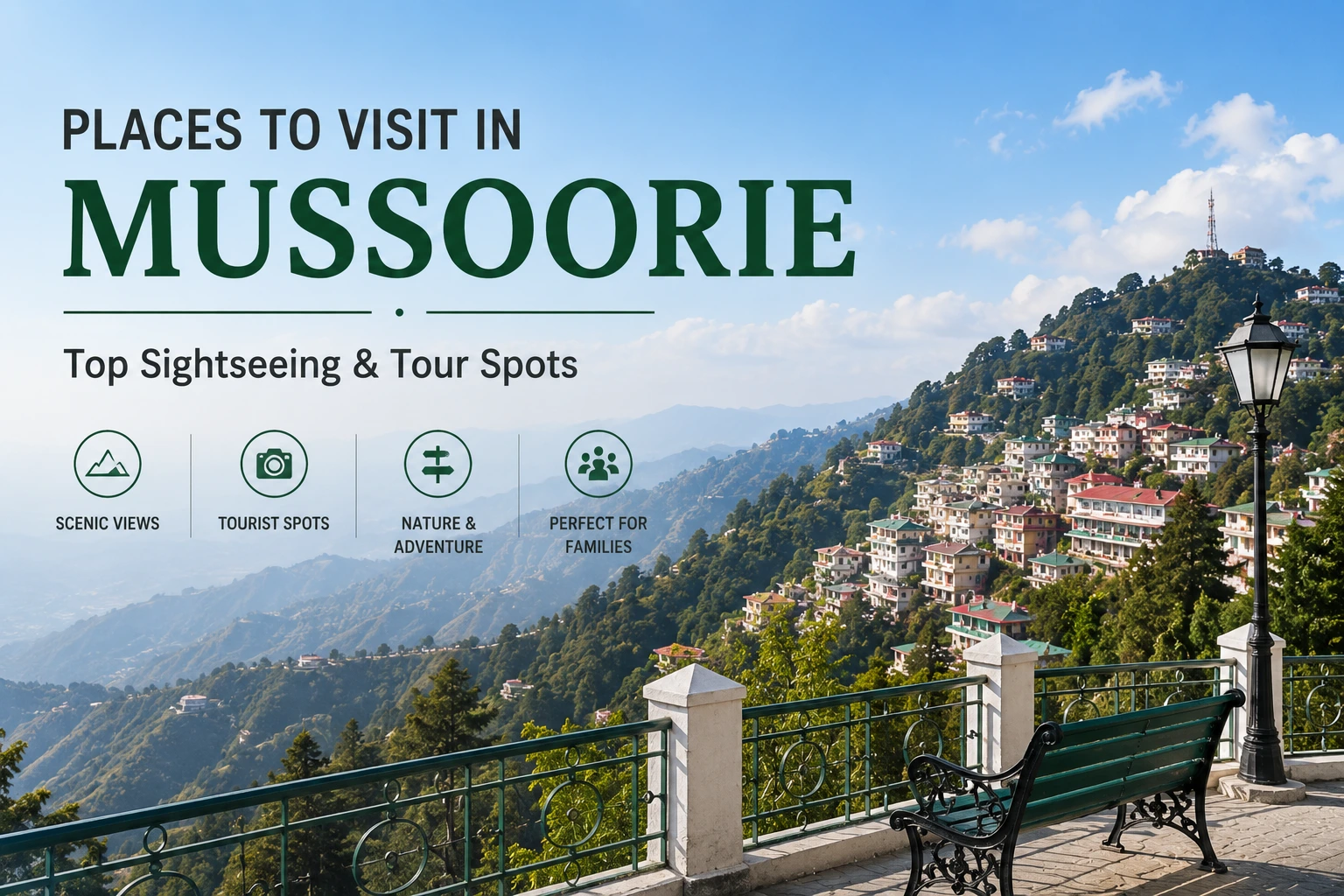
Mussoorie's top places to visit include Mall Road, Gun Hill, Kempty Falls, Lal Tibba, Camel's Back Road, Cloud's End, Jharipani Falls, and the quieter neighbourhood of Landour. Most of these are reachable on foot or by local taxi within the town. For a complete trip, two days is enough to cover the main attractions comfortably — one day for Mussoorie's classic spots and one for Landour and the less-touristy viewpoints.
Places to Visit in Mussoorie — A Real Traveller's Guide
There's a reason Mussoorie has been pulling people up that winding road from Dehradun for well over a century. The hill station sits at around 2,005 metres above sea level, looking down at the Doon Valley on one side and out toward the snow-dusted Himalayan peaks on the other. On a clear winter morning, you can see far — genuinely far — and that view alone is worth the drive.
But Mussoorie is more than Gun Hill selfies and Kempty Falls crowds. There's Landour with its colonial lanes and unhurried pace, there's Cloud's End where the town simply fades into forest, there's the long arc of Camel's Back Road at dawn, and there are small cafés where you can sit with a warm cup and watch the mist roll in from the valley. This guide covers all of it — the famous places, the underrated ones, tips for December visits and night plans, and a two-day itinerary that actually makes sense.
Top Places to Visit in Mussoorie
Mall Road
Mall Road is the spine of Mussoorie — a pedestrian-friendly stretch lined with shops, dhabas, bakeries, and old hotels that have been here since the British era. It runs between Library Chowk and Kulri Bazaar, and at any hour of the day there's something happening on it. Early mornings are the best: the light is golden, the crowds are thin, and you can actually see the Doon Valley clearly before the haze sets in.
Private vehicles are restricted on Mall Road during peak hours, so you walk, hire a rickshaw, or use the ropeway. Don't rush it. The street food here — particularly the Tibetan momos and local bakery items — is worth stopping for.
Gun Hill
At 2,122 metres, Gun Hill is the second-highest point in Mussoorie and offers panoramic views of the Himalayan ranges including the Bandarpunch and Srikanta peaks. The ropeway ride from Mall Road takes you up in about five minutes and is an experience in itself — especially with snow-capped peaks in the backdrop during winter.
The hilltop has small stalls, telescope rentals for peak-spotting, and plenty of space to simply stand and take in the view. Go early in the morning for the clearest visibility. By mid-morning on peak season days, haze and crowds begin to build. Entry to the ropeway is charged separately.
Kempty Falls
Kempty Falls sits about 15 km from Mussoorie town on the Yamunotri Road — a multi-tiered waterfall that drops around 40 feet into a natural pool below. It's one of the most visited spots in the region, which is both its claim to fame and its main drawback. During May–June and October–November, the area around the falls gets heavily crowded.
That said, if you go early (before 9 AM) on a weekday or visit during the quieter months of February–March, Kempty is genuinely beautiful — the surrounding forested hills, the cold mist from the falls, and the sound of the water make it worth the trip. A ropeway connects the road level to the pool base. The pool is open for bathing and is popular with families.
Lal Tibba — The Highest Point in Mussoorie
Lal Tibba is the highest point in Mussoorie at 2,275 metres and sits about 6 km from the Library Chowk in the Landour area. What makes it special is the observation telescope installed here — on a clear winter day, you can see Badrinath, Kedarnath, Gangotri, and the entire high Himalayan ridge spread out like a map. It's one of those experiences that stays with you.
The area around Lal Tibba is part of the Landour cantonment, so it's quieter and more pine-forested than Mussoorie's busy centre. The Lal Tibba Depot café nearby is a good place to sit with coffee and enjoy the altitude without the tourist rush. Sunrise visits are excellent here.
Landour
Landour is what Mussoorie was before it became a tourist destination. This cantonment town sits about 400 metres higher than Mall Road, and its pace is entirely different — old stone paths, colonial bungalows behind iron gates, oak and rhododendron trees overhead, and a long silence broken only by birds. Ruskin Bond, India's most beloved nature writer, has lived here for decades. The town feels like it's been quietly keeping its own counsel all along.
The famous Char Dukan (literally "four shops") is the social centre of Landour — a small cluster of cafés and stores where locals, old Mussoorie hands, and a handful of travellers who know about it come for breakfast or tea. Try Anil's Café or Prakash Store. From Char Dukan, you can walk up to Lal Tibba or wind along the Chukkar — a circular walking path that loops the upper ridge with views in every direction.
Most visitors can walk from Landour Bazaar to Char Dukan — it's about 1 km uphill, manageable for most people though noticeably steep. Beyond Char Dukan, it's a longer walk to Lal Tibba. A shared taxi or auto from Mussoorie to Landour Bazaar costs around ₹50–₹100 per person.
Camel's Back Road
Camel's Back Road is a 3 km walking and horse-riding path that curves around the northern ridge of Mussoorie, named for a natural rock formation that resembles a camel's hump. The path runs from Kulri Bazaar around to the Library end, and along the way offers some of the best valley and mountain views in Mussoorie without requiring any serious effort.
Early mornings here are excellent — the Doon Valley is often shrouded in mist below, the peaks emerge slowly to the north, and the road is quiet enough to actually hear the forest. Horses are available for hire if you'd rather ride. The road is also one of the few places in Mussoorie where you can walk freely without navigating tourist crowds.
Cloud's End
Cloud's End is at the western edge of Mussoorie — roughly 6 km from Library Chowk — where the road ends and the forest begins. It's the point where Mussoorie essentially stops being a town and becomes a hillside. There's a heritage hotel here (Cloud's End Forest House) and a walking trail that leads into the Benog Wildlife Sanctuary.
Most tourists miss it entirely, which is exactly why it's worth going. The air here feels cleaner, the forest denser, and the views toward the Aglar River valley below are uninterrupted. If you're spending two days in Mussoorie and want one experience that feels genuinely unhurried, this is it.
Jharipani Falls & Bhatta Falls
Jharipani Falls is about 8.5 km from Mussoorie on the Rajpur Road side, accessible by road and then a short walk through forest. It's a smaller waterfall than Kempty and sees significantly fewer visitors, which makes it a much more peaceful experience — especially after monsoon (September–October) when the water flow is strong and the surrounding greenery is at its best.
Bhatta Falls is another option about 7 km from Mussoorie toward Dehradun, with a short 1.5 km walk from the road. Neither of these falls are major tourist infrastructure — there are no large crowds, no souvenir stalls — just forest, water, and quiet. If you're staying two days and have already seen the main spots, these make for an ideal half-day excursion.
Benog Wildlife Sanctuary
Spread across about 237 hectares on the western slopes of Mussoorie, Benog Wildlife Sanctuary is primarily known for its birdlife — over 150 species including the red-billed blue magpie, Himalayan griffon, and white-capped water redstart have been recorded here. The sanctuary is accessible from Cloud's End and is open for nature walks with a guide.
For wildlife enthusiasts, bird photographers, or anyone who wants to spend a few quiet hours in proper Himalayan oak and rhododendron forest, Benog is easily one of the best places in Mussoorie that doesn't appear on most tourist itineraries. Go early morning for birds; the sanctuary is typically open from sunrise.
Company Garden (Municipal Garden)
Company Garden — officially called the Municipal Garden — is about 3 km from Mussoorie's Library Chowk and sits at a slightly lower altitude with a good spread of flower gardens, small waterfalls, and a boating lake. It's managed by the municipal authority and has a small entry fee. For families with children, this is one of the more relaxed spots in Mussoorie — there are amusement rides, flower beds, and wide open areas to sit.
It gets crowded on weekends and during peak season, but on quieter days it's a pleasant 1–2 hour visit. The garden is particularly colourful in spring (March–April) when the flowering plants are at their peak.
Places to Visit in Mussoorie at Night
🌙 Mussoorie After Dark — What's Worth Doing
- Mall Road evening walk — The best version of Mall Road is after 7 PM when the shops are lit up, the food stalls are busy, and the air cools sharply. The illuminated valley below looks entirely different at night.
- Kulri Bazaar — The eastern end of Mall Road transitions into Kulri Bazaar where you'll find better local food options and a slightly less tourist-heavy atmosphere in the evenings.
- Rooftop cafés and restaurants — Several restaurants along Mall Road have rooftop seating with valley views. The experience of eating dinner while watching the lights of Dehradun and Rishikesh far below in the valley is genuinely striking.
- Gun Hill by night (seasonal) — The ropeway sometimes operates extended evening hours during peak season. The view of the valley lights from Gun Hill summit at night is excellent, though check operating hours before planning.
- Landour Bazaar — A very quiet, more authentic evening option. The Char Dukan area closes early, but the Landour Bazaar itself has local shops and a completely different atmosphere from the tourist-facing Mall Road.
⚠️ Note: Mussoorie doesn't have a late-night scene the way a city does. Most restaurants wind down by 10 PM and the town gets quiet after that. The evening experience here is best described as peaceful rather than lively.
Planning a Trip to Mussoorie?
Book a cab from Dehradun, Haridwar, or Rishikesh — one-way, round-trip, or a full Uttarakhand package. DivyaShree Cabs has been operating since 2012.
Mussoorie Places to Visit in December
December is one of the most atmospheric months to visit Mussoorie, though it's also the beginning of the cold season — temperatures at night regularly drop to 2–5°C, and snowfall is possible from mid-December onward. That said, the crowds are significantly thinner than in summer, the air is exceptionally clear, and on good days the Himalayan views from Lal Tibba or Gun Hill are at their absolute best.
❄️ Best Spots for a December Visit
- Lal Tibba — Crystal-clear peak visibility on winter mornings. Bring binoculars or use the telescope on site.
- Landour and Char Dukan — The cantonment area is magical in winter with frost on the trees and barely any tourists.
- Camel's Back Road — Morning walks with snow-capped peaks visible from the ridge. One of Mussoorie's finest winter experiences.
- Gun Hill — The ropeway operates through December and the peak views from the top are worth it.
- Kempty Falls — Water flow reduces in winter but the surrounding forest scenery is beautiful and the crowds are gone.
- Benog Wildlife Sanctuary — Winter is excellent for birdwatching here. Many migratory species arrive in November–December.
Pack thermals, a good jacket, gloves, and non-slip footwear — the steps and paths can be icy after snowfall. A private cab with an experienced hill driver is strongly recommended during December, especially if snowfall has occurred recently.
💡 Snowfall tip: If you're visiting specifically for snowfall, keep an eye on weather forecasts. Snow usually arrives from late December through January and February. Check with your hotel or cab operator before heading up — the Rajpur Road can become slippery and occasionally gets temporarily blocked right after heavy snowfall.
How to Spend 2 Days in Mussoorie — A Practical Itinerary
Two days is enough to cover Mussoorie's main attractions at a reasonable pace — not rushed, not padded out with filler stops. Here's how to plan it sensibly:
Classic Mussoorie
- Early morning: Mall Road walk before crowds arrive
- Mid-morning: Gun Hill ropeway and views
- Late morning: Camel's Back Road walk
- Lunch: Mall Road or Kulri Bazaar
- Afternoon: Company Garden or Jharipani Falls
- Evening: Mall Road again — street food and valley lights
- Night: Dinner at a rooftop restaurant
Landour & Beyond
- Early morning: Drive or taxi to Lal Tibba for sunrise views
- Breakfast: Char Dukan — Anil's Café or Prakash Store
- Mid-morning: Walk the Landour Chukkar path
- Late morning: Cloud's End and forest walk
- Lunch: Landour Bazaar or back in Mussoorie
- Afternoon: Kempty Falls (go on return route toward Dehradun)
- Evening: Departure or overnight stay
📍 Cab tip: For Day 2, a private cab hired locally for the day works out well — Lal Tibba, Cloud's End, and Kempty Falls are spread out and walking between them isn't practical. A local Mussoorie cab for the day costs roughly ₹1,500–₹2,500 depending on the vehicle type and total distance.
Places to Visit in Dehradun and Mussoorie Together
Many travellers combine Dehradun and Mussoorie into a single trip — which makes sense given that Dehradun is just 35 km from Mussoorie. If you have 3–4 days, you can cover the best of both without feeling rushed. Here's a quick planning guide:
| Location | Top Spots | Best Done From |
|---|---|---|
| Mussoorie | Mall Road, Gun Hill, Landour, Lal Tibba, Kempty Falls | Stay in Mussoorie |
| Dehradun | Robber's Cave, Sahastradhara, Tapkeshwar Temple, Mindrolling | Stay in Dehradun |
| Day Trip Options | Kempty Falls, Dhanaulti (32 km from Mussoorie), Surkanda Devi | From Mussoorie |
| Nearby Add-ons | Rishikesh, Haridwar (pilgrimage + rafting) | From Dehradun |
Dhanaulti deserves a special mention here — it's 32 km from Mussoorie on the Chamba Road and is one of the most underrated hill spots in Uttarakhand. Much quieter than Mussoorie, with a dense eco-park of deodar forest, good views, and far fewer tourists. If you have an extra half-day, Dhanaulti is worth the drive. A local cab from Mussoorie to Dhanaulti and back costs roughly ₹1,000–₹1,800 depending on vehicle type.
For onward Uttarakhand travel, Mussoorie also sits at a convenient junction. Many travellers use it as a starting point before heading toward Kedarnath or Badrinath via Dehradun. Our Char Dham taxi service from Dehradun covers this entire route.
Heading to Kedarnath or Char Dham After Mussoorie?
We operate full Char Dham and Do Dham taxi packages from Dehradun, Haridwar, and Rishikesh. Plan your complete Uttarakhand journey with one call.
Frequently Asked Questions — Places to Visit in Mussoorie
-
Mussoorie is most famous for its panoramic Himalayan views, the colonial-era Mall Road, Gun Hill, and Kempty Falls. Beyond the tourist trail, it's also known for Landour — the quiet cantonment neighbourhood associated with author Ruskin Bond — and for its position as one of the most accessible hill stations from Delhi and Dehradun. The town also has a strong British-era heritage visible in its architecture, church buildings, and the old boarding schools that dot the hillside.
-
Day 1: Start with Mall Road in the morning before crowds arrive, take the ropeway up to Gun Hill, walk Camel's Back Road, and spend the evening back on Mall Road with dinner at a valley-view restaurant. Day 2: Head to Lal Tibba at sunrise for the best Himalayan views, breakfast at Char Dukan in Landour, walk the Chukkar path, visit Cloud's End, and stop at Kempty Falls on your way back toward Dehradun. This two-day plan covers the highlights without rushing.
-
The top 5 places to visit in Mussoorie are: (1) Mall Road — the heart of the town, best in early morning or evening; (2) Gun Hill — best views of the Himalayan peaks, accessible by ropeway; (3) Landour — quieter, higher, more authentic than Mussoorie town; (4) Lal Tibba — the highest point in Mussoorie with an observation telescope; and (5) Kempty Falls — a classic 40-ft waterfall with a natural pool, best visited early to avoid crowds.
-
It depends entirely on what kind of trip you want. Mussoorie town (Mall Road area) gives you easy access to restaurants, shops, ropeway, and all the tourist activity. It's convenient but can feel crowded in peak season. Landour is quieter, higher, and has a completely different character — heritage bungalows, forest paths, Char Dukan, and almost no tourist crowds. If you want relaxation and authenticity, Landour is superior. If it's your first time and you want easy access to everything, stay in Mussoorie and do Landour as a day visit.
-
Mussoorie is particularly known for its Tibetan momos — steamed or fried dumplings available at many stalls and small restaurants along Mall Road and Kulri Bazaar. The town also has excellent local bakeries with fresh bread, pastries, and Christmas cakes (a tradition from the British-era boarding schools). Maggi with cheese, hot corn on the cob, and roasted peanuts are the classic hill station snacks. In Landour, the Char Dukan cafés serve good coffee, omelettes, and simple breakfast plates in a setting that makes everything taste better.
-
Avoid Mussoorie during peak summer (mid-May to mid-June) and peak autumn (mid-October to early November) if you dislike crowds. These are the busiest periods when the Dehradun–Mussoorie road gets heavily congested on weekends — sometimes adding 1–2 hours to what is normally a 1-hour drive. Monsoon (July–August) brings heavy rain and the risk of landslides on the hill road, so travel requires caution during this period. The quietest and most peaceful times to visit are February–March (after snowfall season, before summer rush) and September (just as monsoon winds down).
-
Yes, you can walk from Mussoorie to Landour — the distance from Library Chowk or Mall Road area to Landour Bazaar is about 2–3 km, and from Landour Bazaar to Char Dukan is another steep 1 km uphill. Most people in reasonable health can manage it, though the ascent is noticeable. The walk through the narrow lanes leading up to Landour is pleasant — lined with old stone walls, overhanging trees, and occasional viewpoints. If you'd rather not walk the full distance, shared taxis and autos run between Mall Road and Landour Bazaar.
-
Landour is famous for three things primarily: Ruskin Bond (the author has lived here for decades and is occasionally seen around Char Dukan on weekend mornings), its preserved colonial architecture including the old stone church and cantonment bungalows, and Char Dukan — the small cluster of cafés at the top of Landour Bazaar that has become a quiet pilgrimage spot for readers and slow travellers. Landour is also known for its Lal Tibba viewpoint and the Chukkar walking path that loops the upper ridge with outstanding Himalayan views.
-
Chopta in Rudraprayag district is often called the "Mini Switzerland of Uttarakhand" — a high-altitude meadow at around 2,680 metres surrounded by dense oak, rhododendron, and deodar forests. It's the base for the Tungnath temple trek (the highest Shiva temple in the world) and offers sweeping views of Kedarnath, Chaukhamba, and Nanda Devi peaks. Chopta is about 250 km from Mussoorie via Rishikesh and Rudraprayag. It's a completely different kind of destination from Mussoorie — more remote, more dramatic, and accessible by road to the Chopta meadow itself. Some also refer to Dhanaulti (near Mussoorie) and Auli as "Mini Switzerland" for their snow and meadow scenery, but Chopta is the most widely used reference.
-
Landour sits higher than Mussoorie town and is noticeably cooler, especially in shade and after sunset. From October through March, carry thermals, a warm mid-layer (fleece or sweater), and a windproof or insulated outer jacket. In December–February, gloves and a warm hat are essential — temperatures can drop to near-zero at night. From April to June, light layers are enough during the day but carry a jacket for evenings. For footwear, wear comfortable walking shoes with some grip — the paths up to Char Dukan and Lal Tibba are uphill and can be damp or frosty in winter.
More Uttarakhand Travel Guides & Services
Mussoorie is just one part of what Uttarakhand has to offer. Here are more guides and cab services to help plan your complete trip:
Ready to Explore Mussoorie?
Whether you need a cab from Dehradun, Haridwar, Rishikesh, or Jolly Grant Airport — we'll handle the travel so you can focus on the mountains. Serving Uttarakhand since 2012.
Leave A Comment