
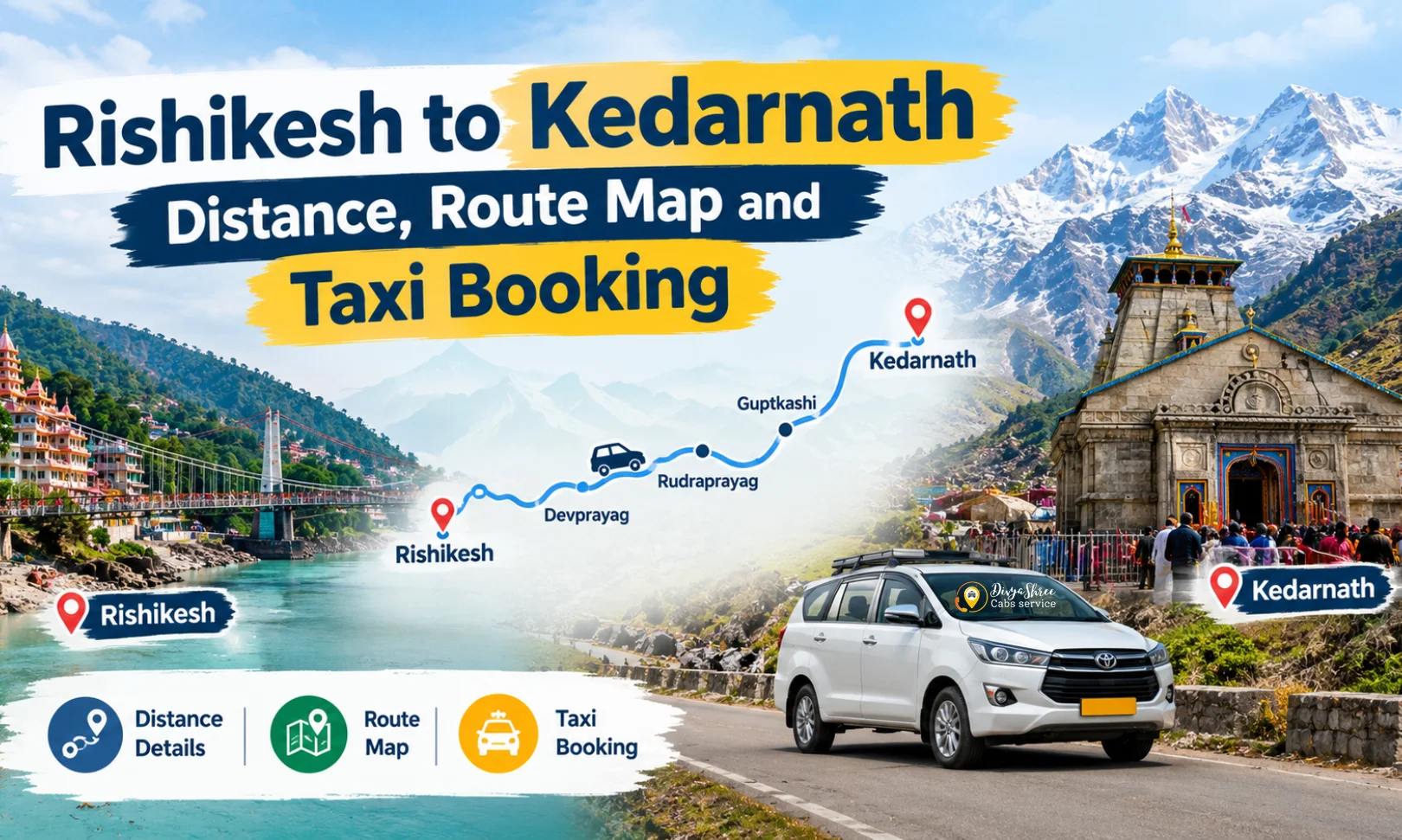
The Rishikesh to Kedarnath distance is approximately 227 km by road to Gaurikund via Devprayag, Srinagar, Rudraprayag, Agastmuni, Guptkashi, and Sonprayag, followed by a 16 km trek from Gaurikund to the temple. The road journey takes roughly 8–10 hours depending on traffic and road conditions, and the trek adds another 5–7 hours on foot, or less by pony, palki, or helicopter. There is no direct train or motorable road all the way to Kedarnath — Rishikesh is the last major town with full rail and bus connectivity, and Sonprayag/Gaurikund mark the end of the road. A private taxi from Rishikesh is the most comfortable way to cover this stretch, with flexible stops at Devprayag, Rudraprayag, and Guptkashi along the way.
Rishikesh to Kedarnath: A Quick Introduction
Rishikesh is the true starting point of the Char Dham Yatra for most travellers. It's the last town on the plains with full rail, road, and air connectivity, sitting right where the Ganga leaves the hills. Whether you're flying into Dehradun's Jolly Grant Airport, taking a train to Haridwar or Rishikesh station, or driving up from Delhi, this is where the mountain leg of your journey to Kedarnath actually begins.
Kedarnath itself sits at roughly 3,583 metres in the Garhwal Himalayas, on the bank of the Mandakini river, and is one of the twelve Jyotirlingas dedicated to Lord Shiva. There is no direct road to the temple — the rishikesh to kedarnath by road journey covers the lower hills through Devprayag, Srinagar, and Rudraprayag, then climbs the Mandakini valley through Agastmuni and Guptkashi to Sonprayag and Gaurikund, where the road ends and the final trek begins.
Because of the distance and elevation change involved, most travellers treat this as a two-day journey each way rather than a single long drive, with an overnight halt around Rudraprayag or Guptkashi being common. If you're combining Kedarnath with Badrinath, our Kedarnath to Badrinath distance guide is a useful next read, and if you'd like the full circuit planned out, see our Char Dham Yatra itinerary.
You can also read our broader Kedarnath travel guide for temple history and darshan tips, or compare this route with the Dehradun to Kedarnath distance and Haridwar to Kedarnath taxi pages if you're starting from a different city.
In plain numbers, the distance from Rishikesh to Kedarnath by road works out to around 227 km to Sonprayag/Gaurikund, and if you convert the full journey — road plus trek — into a single figure, the Rishikesh to Kedarnath km count comes to roughly 243 km end to end. That's a meaningful stretch by Indian hill-road standards, which is exactly why most travellers plan it as a two- or three-day journey rather than trying to rush it in one sitting.
Rishikesh vs Haridwar vs Dehradun: Which Should You Start From?
Most Char Dham travellers arrive in Uttarakhand through one of three towns — Rishikesh, Haridwar, or Dehradun — and all three eventually join the same NH 58/NH 107 corridor toward Kedarnath. Rishikesh sits roughly in the middle of the three and is the most commonly used starting point because of its strong rail and bus links and its position right at the mouth of the Ganga valley.
Haridwar is about 24 km further out on the plains, so the Haridwar to Kedarnath road distance runs a little longer than from Rishikesh, while Dehradun, being further west, adds its own detour before merging onto the same route. If you're flying in, Dehradun's Jolly Grant Airport is the nearest airport to all three towns, and taxis are available from the airport directly to Rishikesh if you'd rather start your yatra from there.
In practice, the choice usually comes down to how you're arriving — by train (Haridwar or Rishikesh station), by air (via Dehradun), or by road from Delhi (through Haridwar). Whichever town you start from, booking a private taxi for the whole stretch to Sonprayag removes the need to change vehicles partway.
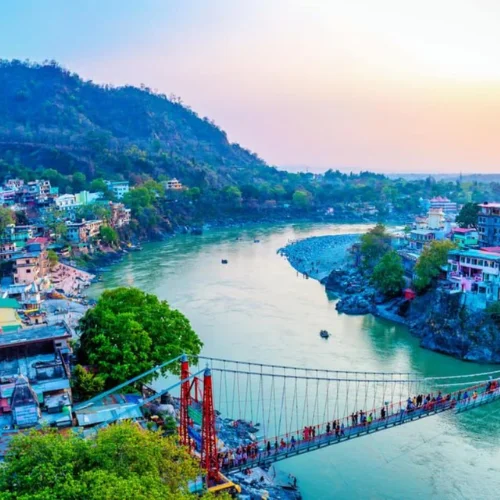
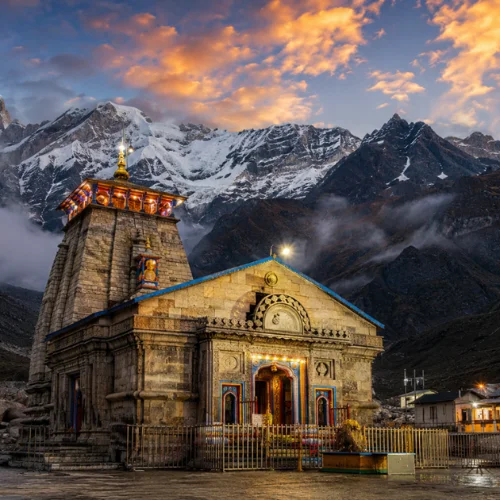
Replace these two placeholders with your own full-size, web-optimised photos before publishing.
Distance from Rishikesh to Kedarnath (and Nearby Points)
Here's how the distance between Rishikesh to Kedarnath breaks down, along with a few related routes travellers commonly ask about.
| Route | Approx. Distance | Approx. Time |
|---|---|---|
| Rishikesh to Kedarnath (via Gaurikund) | 243 km (227 + 16 km) | 8–10 hrs + trek |
| Kedarnath to Rishikesh (return) | ~243 km | 8–10 hrs + trek |
| Rishikesh to Sonprayag (road) | 227 km | 8–10 hrs |
| Sonprayag to Gaurikund | 5–6 km | 10–15 mins |
| Gaurikund to Kedarnath (trek) | 16 km | 5–7 hrs on foot |
| Rishikesh to Devprayag | 74 km | 2 – 2.5 hrs |
| Rishikesh to Rudraprayag | 141 km | 4 – 5 hrs |
| Rishikesh to Guptkashi | ~199 km | 7 – 8 hrs |
| Kedarnath to Badrinath | ~215–235 km | 8–10 hrs |
| Rishikesh to Badrinath | ~295–300 km | 9–11 hrs |
The 227 km / 8–10 hour figure for Rishikesh–Sonprayag reflects the standard NH 58 / NH 107 route through Devprayag, Srinagar, and Rudraprayag. Segment distances are approximate and vary with traffic, weather, road works, and the exact pickup/drop points used, especially during peak yatra season (May–June). Always confirm current road conditions before departure. See our Haridwar to Sonprayag distance guide and Delhi to Uttarakhand distance guide for more on the legs leading up to Rishikesh.
Rishikesh to Kedarnath Map: The Route at a Glance
If you're plotting the rishikesh to kedarnath map in your head before the trip, it's simpler than it looks — there's really only one practical driving route, and it follows the Alaknanda and then the Mandakini river almost the whole way:
Rishikesh → Devprayag → Srinagar (Garhwal) → Rudraprayag → Agastmuni → Guptkashi → Sonprayag → Gaurikund → Kedarnath (trek)
The road runs on NH 58 up to Rudraprayag, then switches to NH 107 for the Mandakini valley stretch through Guptkashi to Sonprayag. It's a well-travelled, BRO-maintained route with fuel stops, dhabas, and hotels at every major town along the way, which is exactly why it remains the most popular road to Kedarnath from the Rishikesh–Haridwar side of Uttarakhand.
Route from Rishikesh to Kedarnath: Stage-by-Stage Breakdown
The road journey follows the Alaknanda and then the Mandakini river valley via NH 58 and NH 107, climbing gradually through several well-known towns before the final trek beyond Gaurikund.
The road follows the Ganga upstream to Devprayag, the sacred confluence where the Alaknanda and Bhagirathi rivers meet and the Ganga is formally born.
A winding stretch along the Alaknanda to Srinagar, one of the larger towns on this route, with fuel pumps and eateries.
The road continues along the Alaknanda to Rudraprayag, another key confluence (with the Mandakini) and the district headquarters where the routes to Kedarnath and Badrinath split.
From here the route branches onto NH 107, following the Mandakini river toward Kedarnath rather than continuing up the Alaknanda toward Badrinath.
Guptkashi is a common overnight halt for travellers splitting the journey across two days, with a good spread of hotels and restaurants.
Sonprayag is the vehicle checkpoint where private taxis typically stop, marking the practical end of the road journey from Rishikesh.
A short shuttle or walk from Sonprayag to Gaurikund, the true trailhead where the motorable road ends completely.
The final 16 km uphill trek to the temple — most travellers complete this stretch in 5–7 hours on foot, with pony, palki, and helicopter options also available.
Together, these stages add up to roughly 227 km of road from Rishikesh to Sonprayag/Gaurikund, plus the 16 km trek to Kedarnath. Individual segment distances are approximate and will vary slightly with the exact roads and stops your driver takes; always confirm current conditions before departure, especially in monsoon.
How to Reach Kedarnath from Rishikesh
Rishikesh is well connected by rail, road, and air, but every route ends the same way — by road to Sonprayag/Gaurikund, then on foot or by pony, palki, or helicopter.
Door-to-door from Rishikesh railway station, bus stand, or your hotel straight to Sonprayag/Gaurikund, with flexible overnight stops en route.
Uttarakhand roadways buses and shared jeeps run this corridor in stages, usually with a change at Rudraprayag or Guptkashi.
Rishikesh has its own railway station; Dehradun's Jolly Grant Airport is the nearest airport. Both require the same onward 227 km road journey.
Buses from Rishikesh to Sonprayag
Uttarakhand Roadways and GMOU-operated buses run regularly on the Rishikesh–Rudraprayag–Guptkashi–Sonprayag corridor, especially during the peak yatra season from May to October. Most travellers take a direct bus where available, or break the journey with a change at Rudraprayag or Guptkashi if a direct service isn't running that day.
Buses are the most economical way to cover this route, but they run on fixed timings, make several stops, and can take noticeably longer than a private taxi — especially during peak season when the road through Rudraprayag gets congested. For families, elderly travellers, or anyone short on time, a private taxi remains the more comfortable option, with the flexibility to start early, stop when you need to, and avoid waiting for the next available bus.
Where to Stay Along the Way
Since most travellers split the rishikesh to kedarnath by road journey across two days, choosing the right overnight halt matters. Guptkashi has the widest spread of hotels and guesthouses on this route, ranging from budget rooms to more comfortable mid-range options, and it sits close enough to Sonprayag that you can reach the trailhead early the next morning.
Sonprayag itself has more limited but workable options if you'd rather stay right at the vehicle checkpoint, while Gaurikund has very few rooms and mostly functions as a transit point rather than a place to rest overnight. Near the temple itself, GMVN guesthouses and dharamshalas offer basic stays for pilgrims who trek up and want to spend the night close to Kedarnath before heading back down.
During peak season (May–June) and around major festivals, rooms at every one of these stops fill up quickly, so booking a few weeks ahead — or letting your driver help arrange a stay — is a good idea rather than assuming you'll find something on arrival.
Altitude, Health, and Safety Tips
Kedarnath sits at 3,583 metres, high enough that mild altitude symptoms — headache, breathlessness, or fatigue — are common, especially if you rush the trek. Walking at a steady, unhurried pace, staying hydrated, and taking short breaks rather than long ones helps most people adjust reasonably well over the 5–7 hour climb.
Travellers with heart conditions, severe asthma, or other chronic health issues should consult a doctor before attempting the trek, and consider a helicopter or pony instead of walking. It's also worth carrying a basic first-aid kit, any personal medication, and enough warm layers — temperatures can drop quickly once the sun goes down, even during the summer season.
On the road itself, the biggest safety factor is timing your travel around the weather. Avoid driving after dark on the hill stretch where possible, and during monsoon months, build extra buffer time into your schedule in case of landslide-related delays or road closures.
What to Pack for the Trip
A fleece or light jacket, a windproof outer layer, and thermal wear for the evenings near Kedarnath.
Broken-in, grippy footwear for the 16 km paved trekking path, plus a spare pair of socks.
A poncho or raincoat, since weather in the hills can turn quickly regardless of season.
ATMs are scarce beyond Rishikesh — carry sufficient cash plus a valid photo ID and your Yatra registration.
Personal medicines, pain relief, and any altitude-related medication your doctor recommends.
A pole helps on the steadier uphill sections, and a refillable bottle covers the many water points en route.
Best Taxi Service for Char Dham & Uttarakhand Tours
DivyaShree Cabs is built to be the go-to taxi service for Char Dham Yatra, Uttarakhand tours, and general sightseeing across the Garhwal region — including long routes like Rishikesh to Kedarnath. See our full Char Dham Yatra taxi service and cab for Char Dham Yatra pages for the wider circuit.
Drivers experienced on the full Rishikesh–Rudraprayag–Guptkashi–Sonprayag corridor and beyond.
Sedans, Ertiga, Innova/Crysta, and Tempo Travellers, serviced and ready for long hill journeys.
Clear, confirmed pricing on call — no last-minute surprises on your route or vehicle.
Easy booking and trip support by phone or WhatsApp at 9368028472, before and during your Yatra.
Whether it's a Char Dham Yatra or a Garhwal sightseeing trip, our vehicles suit both.
We help booked travellers understand Char Dham registration and green card requirements.
Book a Rishikesh to Kedarnath Taxi — Fleet & Fare Guidance
Choose a vehicle based on group size and comfort needs. Exact fares depend on season, vehicle availability, number of days and route (one-way vs round trip) — call or WhatsApp us for a confirmed quote.
Sedan (Dzire / Etios)
Ideal for 2–3 travelers, light luggage
Starting from ₹4,000 - ₹4,500*/day, one-way
SUV (Ertiga / Innova)
Best for families, 5–7 travelers with luggage
Starting from ₹5,000 - ₹5,500*/day, one-way
Prime SUV (Innova Crysta)
Premium comfort for longer mountain drives
₹5,500 - ₹6,000*/day, one-way
*Indicative starting fares only — actual quote depends on season, exact dates, vehicle availability, toll/parking and number of travel days. Confirm final pricing by phone or WhatsApp before booking.
Fares depend on the vehicle type, whether it's a one-way drop or round trip with waiting days, and the season. The table below is a planning guide only — always confirm the exact fare on call before booking. Prices may vary by season, vehicle condition, fuel rates, and availability, and typically run higher during peak yatra months (May–June) and around major festival dates.
Char Dham Yatra registration, including for Kedarnath, is mandatory and is managed online through the
Uttarakhand government's official Char Dham Yatra portal, along with registration counters at Haridwar
and Rishikesh. Requirements can change year to year, so confirm current rules close to your travel dates
— see our full green card for Char Dham Yatra guide for details.
Kedarnath is open only for part of the year — the temple typically opens in late April and closes around mid-November (roughly six months), with exact dates announced each year on the Hindu Panchang calendar. Clear skies and the temple freshly reopened, but also peak crowds — book taxi and stay well ahead. Post-monsoon skies are usually clearer, with thinner crowds than peak summer. Monsoon season carries higher landslide risk along the hill road — check advisories closely.
The 16 km trek from Gaurikund to Kedarnath is rated moderate rather than technically difficult — there's
no climbing or exposed scrambling involved, just a long, steady uphill walk on a paved mountain path that
gains a fair amount of altitude. What makes it feel harder for many people isn't the terrain itself, but
the combination of distance, altitude, and being out of regular walking practice.
Basic fitness, comfortable trekking shoes, trekking poles, and a slow, steady pace with regular breaks
make it manageable for most healthy adults. Elderly travellers or anyone with joint or heart conditions
should consider a pony, palki (palanquin), or helicopter instead. Whichever option you choose, starting
early from Gaurikund helps you avoid the afternoon crowd and any weather that tends to roll in later in
the day.
Total cost depends heavily on your choices — taxi vs. bus, shared room vs. hotel, walking the trek vs.
taking a helicopter or pony. As a rough guide, a budget traveller using buses, shared dormitories or
basic guesthouses, and walking the trek can expect to spend meaningfully less than someone booking a
private taxi, mid-range hotels, and pony or helicopter services for the final stretch.
A tight budget of around ₹5,000 can cover a very basic solo trip if you're using buses, dormitory-style
stays, and walking the trek yourself — but it leaves little room for a helicopter ride, a private taxi,
or comfortable hotel stays. For a more comfortable, less exhausting trip — especially with family or in
a group — budget meaningfully more and build in a private taxi for the road leg. Costs also rise sharply
in peak season (May–June) and around major festivals, so it's worth pricing your trip closer to your
actual travel dates rather than relying on off-season estimates.
The small market stretch near Gaurikund and around the Kedarnath temple complex sells mostly
devotional and practical items: rudraksha malas, Shiva idols and pendants, prasad, woollen caps and
gloves for the cold, walking sticks, and basic trekking gear like raincoats and ponchos. It's a good
place to pick up a rudraksha mala or a small Shiva idol as a keepsake, but don't expect elaborate
handicrafts — this is a pilgrimage stop, not a shopping town, and most of what's on sale is there to
support the yatra itself.
Given the 227 km road journey plus a 16 km trek each way, most travellers need at least 3 days from Rishikesh — 2 days is tight but possible if you're fit and start early. Day 1: Rishikesh to Guptkashi/Sonprayag by taxi, overnight halt. Day 2: Drive to Sonprayag, trek to Kedarnath, darshan, overnight near the temple or trek partway back. Day 3: Trek down to Gaurikund, drive back to Rishikesh. Requires a very early Day 1 start from Rishikesh, driving straight through to Sonprayag and trekking up the same day (or using a helicopter), with darshan and the return trek/drive on Day 2. Best suited to fit travellers with flexible energy levels.
Late April and May, right after the temple reopens, bring cool mornings, mild afternoons, and clear
Himalayan views — but also the heaviest crowds of the year, since this is when the Yatra season begins
and pent-up demand from the winter closure peaks. June carries a similar pattern, though the heat starts
building in the plains sections of the drive near Rishikesh.
July and August are monsoon months, and this is genuinely the riskiest window to travel this route —
landslides, road blockages, and swollen rivers along the Alaknanda and Mandakini valleys are common, and
the trek itself becomes slippery and harder to manage safely. Many experienced travellers simply avoid
this period unless they have no other choice.
September through early November is often considered the best all-round window: the monsoon has cleared,
the mountain air is crisp, visibility is at its best, and crowds thin out compared to the May–June rush.
By mid-November the temple closes for winter, and the route effectively shuts down for pilgrimage traffic
until the following spring.
Most travellers break the 227 km road journey to Sonprayag with an overnight halt around Rudraprayag or Guptkashi. Temperatures near Kedarnath stay cool even in summer and drop sharply after sunset. Vehicles fill up quickly in peak season (May–June) and around major festival dates. Consider a pony, palki, or helicopter for the final stretch if walking the full 16 km isn't comfortable. ATMs are scarce beyond Rishikesh, so withdraw what you need before heading up. Landslides are more frequent in July–August; check advisories before setting out.
Since you're already covering a good stretch of the Garhwal Himalayas to reach Kedarnath, it's worth
considering a few nearby add-ons rather than driving straight back to Rishikesh. Chopta and the
Tungnath–Chandrashila trek sit not too far off the same corridor, and our
how to reach Chopta guide
covers that detour in detail.
If your group has more time, pairing Kedarnath with Badrinath is the classic extension, since both
routes branch off from Rudraprayag — see our
Kedarnath to Badrinath distance page for that leg. Travellers who prefer a spiritual detour on the
way back sometimes add Kainchi Dham near Nainital; our
Rishikesh to Kainchi Dham distance guide has the details for that side trip.
For families or groups splitting time between pilgrimage and hill-station leisure, Mussoorie is a
popular add-on before or after the Yatra — check our
places to visit in Mussoorie and
how to reach Mussoorie guides if that fits your plans. Whichever combination you choose, tell us
your full itinerary when you call — we can plan the taxi around every leg rather than booking each one separately.
By private taxi, bus, or shared jeep along NH 58 and NH 107 to Sonprayag/Gaurikund (about 227 km), followed by a 16 km trek, pony ride, palki, or helicopter to the temple. A private taxi is the most comfortable option for the road leg. Yes, 3 days from Rishikesh is a comfortable plan: one day to reach Guptkashi/Sonprayag, one day to trek up, do darshan, and rest, and one day to trek down and drive back. Kedarnath is typically closed from around mid-November to late April, roughly six months, due to heavy snowfall. Exact dates are announced each year on the Hindu Panchang calendar and can shift slightly. The easiest way is a private taxi from Rishikesh or Haridwar straight to Sonprayag, followed by a pony, palki, or helicopter for the final stretch instead of walking, if you'd rather avoid the trek. It's tight but possible for fit travellers with a very early start on Day 1, driving straight to Sonprayag and trekking up the same day, or using a helicopter to save time. Rudraksha malas, Shiva idols and pendants, prasad, and practical trekking items like woollen caps, gloves, and raincoats are the most commonly bought items near the temple and Gaurikund market. A very basic solo trip using buses, dormitory stays, and walking the trek can work on around ₹5,000, but it leaves no room for a private taxi, hotels, or helicopter/pony services. Budget more for comfort or group travel. It's rated moderate — a long, steady 16 km uphill walk on a paved path with no technical climbing. Basic fitness and a slow pace make it manageable; a pony, palki, or helicopter is a good alternative for anyone who'd struggle with the distance and altitude. Cost depends on your choices of transport, stay, and how you cover the trek. Call 9368028472 for a current taxi fare quote based on your group size and dates. Kedarnath to Badrinath is roughly 215–235 km by road (via the Rudraprayag route), since there's no direct road between the two shrines. See our Kedarnath to Badrinath distance guide for the full breakdown.Rishikesh to Kedarnath Taxi Fare Guidance
Vehicle Use Case What Affects Fare Sedan 1–4 travellers, budget trip Season, one-way vs. round trip, waiting days at Sonprayag Ertiga 4–6 travellers Same as above, plus luggage load Innova / Crysta Up to 7 travellers Peak-season demand, number of overnight halts Tempo Traveller 9–17 travellers Group size, multi-day Char Dham itinerary, toll & parking Kedarnath Yatra Registration from Rishikesh
Best Time to Travel from Rishikesh to Kedarnath
Is the Kedarnath Trek Difficult?
How Much Does a Trip from Rishikesh to Kedarnath Cost?
What Is Famous in Kedarnath to Buy?
Can You Visit Kedarnath in 2 or 3 Days from Rishikesh?
What to Expect Month by Month
Travel Tips for the Rishikesh–Kedarnath Journey
Combining Kedarnath with Other Uttarakhand Destinations
Rishikesh to Kedarnath FAQs
How can I go from Rishikesh to Kedarnath?
Can Kedarnath be done in 3 days?
For which 6 months is Kedarnath closed?
How to reach Kedarnath easily?
Can I visit Kedarnath in 2 days?
What is famous in Kedarnath to buy?
Is 5000 enough for Kedarnath?
Is the Kedarnath trek very difficult?
How much does a trip from Rishikesh to Kedarnath cost?
How far is Badrinath from Kedarnath?
Leave A Comment